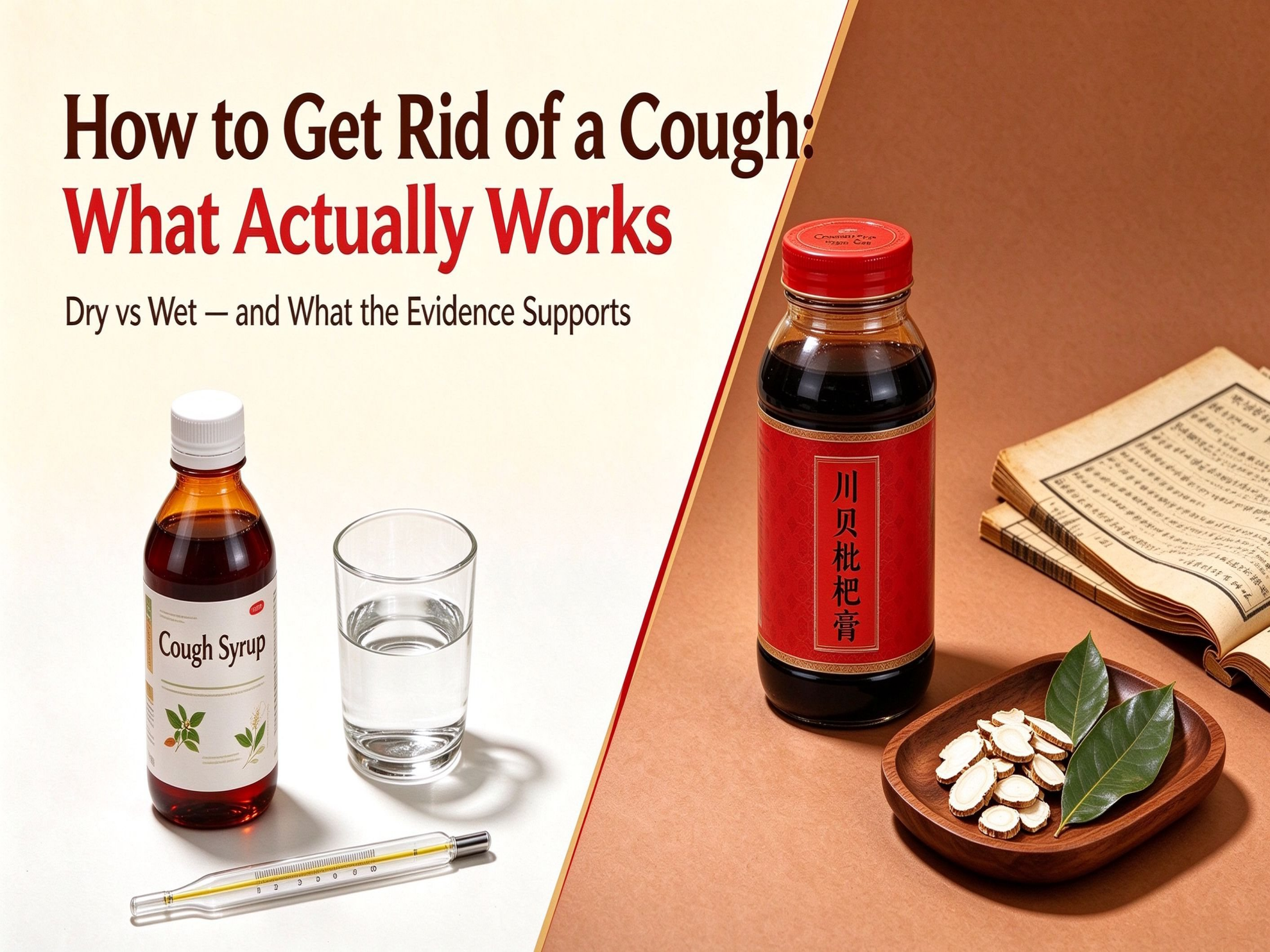
A hospital pharmacist on dry versus wet, what the evidence actually supports, and what gets handed across the counter in China.
There’s no switch that turns a cough off. But a few things genuinely help, and most of the syrups people reach for aren’t on the list. What actually works depends on which cough you have — the dry, tickly kind that keeps you up at night, or the wet kind that’s moving mucus. Get the two confused and you’ll pick the right bottle for the wrong cough and still get no relief.
If anything shows how much we lean on those bottles, it’s the numbers. Over-the-counter cough and cold medicines take in more than $11 billion a year in the United States, and roughly 62% of American households keep at least one such remedy on a shelf. Strip away the branding and it’s a short list of the same ingredients, over and over. Dextromethorphan, the standard cough suppressant, sits inside 85 to 90 percent of all OTC cough medicines. In a 2019 survey of pharmacists, 44 percent named a single dextromethorphan brand as their go-to. Guaifenesin, the expectorant, does the wet-cough work. Honey and throat lozenges round out the shelf.
Ranked by what actually leaves the pharmacy, it comes down to three: the suppressant for the dry cough, the expectorant for the wet one, and the demulcents — honey, hard candy, menthol — for everything in between.
You know every one of those names. That’s not the same as using them right.
What a cough is actually doing
A cough isn’t the illness. It’s the cleanup.
Picture your airway as a hallway lined with a moving walkway — millions of tiny hairs, the cilia, sweeping debris upward all day and all night. When something gets their attention — dust, smoke, the mucus of an infection — the nerves fire a message, and your body answers: a burst of air, thrown out at close to a hundred miles an hour. It’s a reflex, not a malfunction. Most of the time, a cough you can live with is doing its job.
Which turns the goal on its head. You’re not trying to silence a cough at any cost. You’re trying to keep the person comfortable and sleeping while the airway clears — and to catch the coughs that mean something else is going on.
Dry or wet — nearly everything follows from this
Before you buy anything, answer one question honestly: dry or wet?
A dry cough brings nothing up. It itches, it scrapes, it comes in fits, and it’s worst at night — most often the tail end of a cold, or postnasal drip, or simply dry winter air. A wet cough is moving mucus, grey or white or yellow. That’s the body doing exactly what it’s supposed to, which is why you don’t want to shut it down.
Then there’s the clock. Under three weeks is acute, almost always a cold or flu. Three to eight weeks is subacute — the post-viral cough that hangs around long after the rest has left. Past eight weeks, it’s chronic, and that’s a talk with a doctor, not a trip to the syrup aisle.
What actually helps
Honey — and not only as folk wisdom. Trials in children over one show it eases a night cough at least as well as a common cough syrup, and the UK’s health service rates it on par with cough medicine. One rule without exception: never under twelve months, because the risk of infant botulism.
Around that: fluids. A steamy shower. A humidifier, to stop dry air torturing an already raw throat. A hard candy or lozenge, which keeps saliva moving and the throat coated. Sleeping propped up, so postnasal drip doesn’t pool where it makes you cough.
For a wet cough, an expectorant — guaifenesin — with plenty of water can thin the mucus so it comes up instead of sitting there. For a dry cough that’s costing you sleep, dextromethorphan is what people ask for by name. I’ll be honest about it: the evidence that it helps is weak — better than nothing at best, and no cure. Sometimes “weak” is still worth a try at bedtime. Just don’t expect a switch.
That handles the cough. For the cold behind it — the full picture of what actually holds up and what doesn’t — I wrote it out here. And on whether anything you take can keep the next one away, my honest read on vitamin D is here.
What to be careful with
Here’s where I’d slow you down.
Cough medicine and young children don’t belong together. For children under four, the guidance is to avoid over-the-counter cough and cold products altogether — the chance of real harm outweighs any benefit. Under one, honey is off the table too.
Antibiotics do nothing for a cold or a flu, and reaching for them “just in case” is how we get resistance that costs everyone later.
And the quiet one: combination products. Two boxes, two names, the same drug hiding inside — that’s the overdose that doesn’t feel like one. Check the active-ingredient panel before you take a second thing.
When a cough isn’t just a cough
Most coughs pass. These don’t wait for you to “give it another week”: a cough past three weeks that’s getting worse, blood in what you bring up, breathlessness or chest pain, a high fever that won’t settle, a child who’s gone quiet and listless, or weight falling off without reason. Some of those are ordinary; some are a reason to be seen today. You can’t tell from the outside which is which — so let someone qualified look.
The questions I get most
How long should a cough last?
A cold cough usually settles within three weeks. A post-viral one can drag to eight. Past eight weeks, it needs a doctor’s eyes, not another bottle.
Does honey really work?
For a night cough in anyone over one, it’s one of the few home remedies with real evidence behind it — comparable to a standard syrup in trials.
Do cough syrups work at all?
Less than the labels suggest. Some ingredients ease symptoms; few touch the infection itself. The honest framing: they make the wait more bearable.
Why is it always worse at night?
Lying flat lets postnasal drip pool in your throat, and bedroom air is drier. Propping your head up and running a humidifier help more than people expect.
Can I take two things together?
Check the panels first — the same drug hides in more than one box, and stacked doses are how people end up in trouble.
If you’ve read this far, you’re the kind of reader I write for. Once a week I take one thing off the pharmacy shelf — what the label hides, what the evidence says, and what I actually hand across the counter. Subscribe, and it’s free.
The Chinese counter: what lands in front of me
Now the part I keep getting asked about from readers outside China.
I don’t work at an American pharmacy. I work behind a hospital counter in China — seventeen years of it — and this is the shelf that actually passes across. The Western side looks familiar once you translate: dextromethorphan for the dry cough, ambroxol and bromhexine for loosening the wet one. Same logic as the shelf you just read about. The border doesn’t change the pharmacology.
Then there’s one you won’t find in the US: Asmetil, a small compound capsule made by Japan’s Daiichi Sankyo. Four ingredients in one pill — methoxyphenamine, noscapine, aminophylline, chlorpheniramine — doing four jobs at once: cough, wheeze, phlegm, allergy. It’s a prescription drug, it’s on the national insurance list, and it shows up in the Chinese cough guidelines. When a cough comes with a wheeze, this is a name that gets written.
But in China the herbal shelf carries the weight. Look at the market: Chinese patent cough-and-phlegm medicines pulled in over 27.6 billion yuan across the country’s three main markets in 2025. The single best-seller at community pharmacies has been the same honey-steeped fritillaria-and-loquat syrup for years — past 1.8 billion yuan in 2024 alone — and a wind-heat cough syrup now moves more than 34 million bottles a year. If you’re keeping score: the top of the Chinese cough shelf is not Western at all.
A cough in Chinese medicine isn’t one disease
This is what Western readers are most curious about, so let me do it properly.
In Chinese medicine the number of coughs per minute is never the target — the pattern behind them is. The same cough can come from cold, from heat, from dryness, from damp, from lingering depletion, and each is treated differently. That’s why the first questions aren’t about frequency. They’re about chills, sweat, thirst, the sound of the cough, and the color of your tongue.
Three external methods come up again and again. Warming the upper back — moxibustion or a warm compress at Dazhui and Feishu, the points along the spine between the shoulder blades — is used for cold-type and deficient coughs; it’s off-limits for the hot kind, where there’s yellow phlegm, a sore throat, or a fever. Cupping does much the same job for the same patterns. And for children, tui na — a gentle pushing routine that runs down the forearm and works the points on the chest and back — is studied as an add-on therapy, best in the recovery phase, not the acute one. Among the newer folk habits, a home hair-dryer aimed at a child’s back is really an improvised version of this same warming idea. It has no clinical evidence behind it, and it carries a real burn risk, so I won’t recommend it — if you want the warming approach, that’s a job for a licensed practitioner, not an appliance.
Then the classic formulas, each answering to a different pattern. And a pattern isn’t a handful of words. You have to spread it out into a picture before it means anything.
San Ao Tang with Zhi Sou San — wind-cold. It’s a zero-degree day. You went out without a coat and stayed out an hour. You come home shaking, sore down to the bone, nose streaming, sneezing without pause — and for all of that, not a drop of sweat, and the phlegm is thin and white.
Sang Ju Yin — wind-heat. A different road entirely. Your throat is on fire, you’re thirsty, the phlegm has gone yellow and thick, your tongue tip is red.
Sang Xing Tang — wind-dryness, the autumn cough. Dry, rasping, next to no phlegm, throat and nose both parched, worse the moment you talk.
Er Chen Tang with San Zi Yang Qin Tang — damp. The cough that won’t leave, phlegm thick and white, worst first thing in the morning, a heavy, stuffed chest, relief only once the phlegm is out.
Qing Jin Hua Tan Tang — damp that has turned to heat. Yellow, sticky phlegm that won’t come up, breathing that’s short, face flushed, mouth dry.
Sha Shen Mai Dong Tang — the long, dry cough of depletion: little phlegm, sometimes streaked with blood, a hot flush in the afternoon, night sweats.
Each of these was written down, argued over, and refined for the better part of a thousand years. Which is exactly the point — and the warning.
Before you go looking any of this up
One warning before you go shopping for herbs. A cough formula is not a cough syrup with a foreign label; it is chosen to fit a pattern, and the pattern comes first. San Ao Tang, the one people ask about most, is a strong formula — wrong for plenty of people, and not harmless when it is the wrong match. That judgment is made in person, by someone who can see the whole picture. Reading about it is fine. Taking it off a webpage is not — this one included.
Coughs are one of those things every family has a fixed opinion about, usually inherited. If you want the longer version — which old remedies actually do something, and which ones I would not hand across my own counter — that is what I write about weekly.
Tell me what your household reaches for when a cough settles in for the third week. If you are in China, correct me where I got it wrong; if you are elsewhere, tell me what surprised you. Comments are open, and replies to the email reach me directly.
Lin Kai, Licensed Pharmacist (China), 17 years behind the hospital pharmacy counter.
This article is general health education, not a substitute for individual assessment. For a cough that won’t settle — or anything that worries you — see a licensed clinician in person. Please don’t try any of the external methods above, or any formula, on your own. And two hard rules: never give honey to a child under one, and never give over-the-counter cough medicine to a child under four without a clinician’s advice.
Every product on that shelf also carries claims that someone reads line by line — which of these products’ claims would survive a label review.
Sources
- Cough reflex and airway clearance: MedlinePlus, Cough; standard respiratory-medicine references.
- Honey for night cough in children over one: Oduwole et al., Cochrane review, “Honey for acute cough in children,” 2018.
- Cough duration and warning signs: NHS cough guidance; US CDC/AAFP patient guidance.
- Dextromethorphan as the most-used OTC suppressant, ~85–90% of OTC cough medicines: Dicpinigaitis, “The Current and Emerging Treatment Landscape for Chronic Cough,” American Journal of Managed Care, 2022; Consumer Healthcare Products Association (more than 100 OTC products contain DXM).
- US market figures (annual OTC cough-and-cold sales; share of households keeping a remedy): industry data, 2024–25 (CHPA / Astute Analytica); for what the CDC does and does not recommend for a cold, see CDC, Common Cold and Treatment.
- Pharmacist first-choice survey: Pharmacy Times OTC Guide, 2019.
- Asmetil (Compound Methoxyphenamine Capsules): Daiichi Sankyo prescribing information.
- Chinese market figures: Menet (米内网) retail-pharmacy data, 2024–2025; Sinopharm Taiji 2025 annual report (Jizhi syrup, 34 million bottles).
- Formulas: San Ao Tang and Er Chen Tang from the “Taiping Huimin Hejiju Fang” (Song dynasty); Zhi Sou San from Cheng Guopeng’s “Yixue Xinwu” (Qing); Sang Ju Yin, Sang Xing Tang, and Sha Shen Mai Dong Tang from Wu Jutong’s “Wenbing Tiaobian” (Qing, 1798); Qing Jin Hua Tan Tang from “Yixue Tongzhi” (Ming, Ye Wenling), preserved in “Zabing Guangyao”; San Zi Yang Qin Tang from “Hanshi Yitong” (Ming).
Leave a Reply