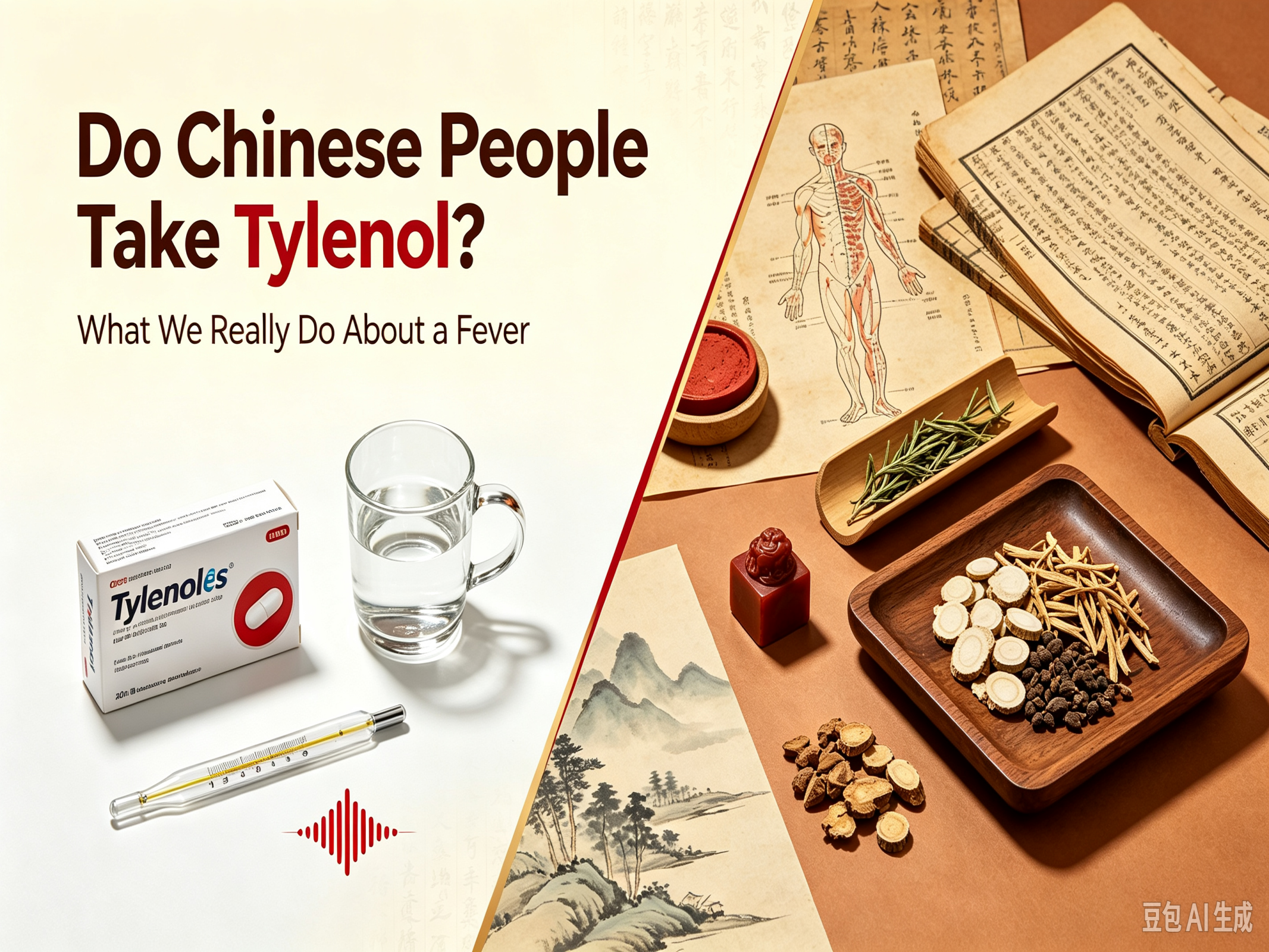
A while back I wrote about ibuprofen — about why “the fever isn’t coming down, so I’ll add a second drug” is the move that lands people in the ER. That post is here: Are You Taking Ibuprofen Wrong?
That post brought a pile of replies. Some came from readers who’d made exactly that mistake and wanted to know what to do next. But most asked something else entirely.
Do you have Tylenol in China? Do Chinese people take ibuprofen too? What do you actually do when someone in the house gets a fever? And my favorite — do Chinese people believe in Western medicine at all, or is it all traditional Chinese medicine over there?
Fair questions. And the honest answer is: it depends on the person, the symptom, and the hour. Let me take them one at a time.
China is a Western-medicine country — mostly
Let’s knock down the biggest misconception right out of the gate. Most public hospitals in China run on Western-medicine care. You feel sick, you go in, you register, you see a doctor, you get blood tests or imaging if it’s called for, and you walk out with a prescription for Western drugs. That’s the mainstream. Most people I know in the city trust evidence-based medicine and reach for it first.
That said, we’re not an either-or country. Traditional Chinese medicine isn’t the alternative fringe here the way it can be in the West. It’s built into the system — many hospitals run a TCM department, there are dedicated TCM hospitals, and TCM sits under the same national insurance umbrella. So it isn’t “Chinese people use TCM instead.” It’s both, side by side, and on some days in the same hallway.
So when do we actually reach for TCM?
A few situations come up again and again.
Physical, hands-on problems — bones, joints, muscles. This is TCM’s deep bench: bone-setting, therapeutic massage (tui na), and acupuncture. For a bad back, a frozen shoulder, a sprain that Western medicine answers with “rest it and wait,” plenty of people go for tui na or acupuncture — for many of them, it brings relief that pills alone have failed to deliver.
When Western medicine runs out of answers. Fatigue, poor sleep, a stomach that misbehaves while every test comes back normal. That’s where people get frustrated and try TCM. Sometimes it brings real relief. And sometimes the improvement comes simply from getting forty minutes of careful listening, instead of a rushed four-minute visit.
And the everyday stuff. Colds, fevers, a cough that drags on — some families treat the whole thing with TCM from the first sneeze, especially the older generation. Which brings us to the rest of this post.
Do we have Tylenol? Yes — and it’s far from the only import
Yes. Walk into almost any pharmacy in China and you can buy Tylenol, or its generic version — acetaminophen, as it’s known in the US, which we call paracetamol here in China and in the UK. Ibuprofen, too, under half a dozen brands.
And while we’re here: China has never been sealed off from foreign drug brands. In a big-city pharmacy you’ll see products from Johnson & Johnson, MSD, Bayer, GSK, and others — many of them sold here for decades. The picture of China as a market where only local medicine exists is simply wrong. If anything, imported brands once carried a certain prestige; even now you’ll hear someone at the counter ask for “the imported one,” the way someone back home might ask for the name brand.
Why do we get a fever at all?
Let’s get this straight first — everything else is easier after.
A fever isn’t the illness. It’s the fire your body lights while it fights a war.
Picture your body as a city. A virus or a bacterium gets past the gates — the skin, the membranes. The garrison, your immune cells, springs into action right away. And what happens on a battlefield? Heat. Deep in your brain there’s a thermostat, the hypothalamus. The moment it gets word of the invasion, it turns the setting up on purpose — from 37 to 38, to 39. Why? Two reasons. Heat makes a lot of germs sluggish and slow to multiply. And it makes your own immune cells faster, more eager, more lethal. You’re heating the city to help your soldiers and to make things harder for the invaders.
So the chills and the shivering aren’t you “catching cold.” They’re your body burning hard to reach that new, higher setting. And once the fighting starts, of course you’re tired, achy, and not hungry.
Which leads somewhere practical: the goal of treating a fever is to keep the person comfortable and safe — not to force the number back to normal. At 38.5 and still yourself, you often don’t need a pill. When a person feels miserable, then you treat. If you are not sure yet whether it is a cold or the flu, the first 48 hours tell you — here is what changes.
What we actually do when someone gets a fever
Here’s the everyday version, the one playing out in millions of Chinese homes.
Someone feels warm. Out comes the thermometer — the old glass one, under the arm, three minutes. A low fever usually gets the treatment it gets anywhere: fluids, rest, light food, and a watching eye. If it climbs, or the person feels rotten, out comes the fever medicine — paracetamol or ibuprofen — and here I’ll hand you straight back to that earlier post: one drug at a time, written down, and never a second one stacked on top just because the first hasn’t worked in forty minutes.
Around the pills there’s the home routine: a cool cloth, a lukewarm wipe-down, no mountain of blankets to “sweat it out.” And the same warning signs send us to the hospital that send anyone, anywhere: a fever past three days, a fever that won’t budge, a stiff neck, confusion, a child who’s gone quiet and listless. A fever isn’t the enemy. It’s a signal.
Now the TCM side — how a fever gets treated
This is the part Western readers are most curious about, so let me do it properly.
In TCM the number on the thermometer is never the target — the pattern behind it is. Wind-cold fever, wind-heat fever, summer-heat fever: they look different and they’re treated differently. That’s why a Chinese medicine doctor asks about chills, sweat, thirst, and the color of your tongue long before they name a single herb.
On the hands-on side there’s a whole toolkit of external methods. The one people bring up most gets translated as bloodletting — though it is nothing like the medieval Western blood-letting of history. It’s a quick, tiny prick at Shixuan, the tips of all ten fingers, or at Dazhui, the bony bump at the base of your neck, releasing just a few drops. It sounds alarming on paper. To be clear: it’s a clinical procedure, done with sterile tools by a trained practitioner, and it’s off-limits for anyone with a bleeding disorder, on blood thinners, pregnant, or badly depleted. It is not a kitchen-table remedy. Alongside it: gua sha, the scraping that raises those purple marks along the back; cupping; and, for children, a gentle rubbing routine known as “clearing the heavenly river,” run down the forearm.
Then the formulas — the classics TCM has leaned on for centuries, each answering to a different pattern. And the “pattern” isn’t a handful of words. It’s a whole person. You have to spread it out into a picture before it makes sense.
Ma Huang Tang. It’s a zero-degree snow day. You went out without a coat and stayed a full hour. You come home huddled and shaking, sore down to the marrow, nose running, sneezing without pause, your skin dry — and for all of that, not a drop of sweat. That’s the pattern Ma Huang Tang answers.
Gui Zhi Tang. Same wind-cold, different picture. You’re sweating a little — but the sweat hasn’t taken the fever with it, and any draft makes you shudder. Your nose is blocked; you feel like gagging. Sweating, yet still afraid of the wind — that’s Gui Zhi Tang.
Yin Qiao San. Wind-heat goes down another road. Your throat is on fire, you’re thirsty, your nasal mucus has gone yellow, your tongue tip is red, and the fever outruns the chill. That’s wind-heat — Yin Qiao San.
Bai Hu Tang. The fever climbs to a new level: you’re burning like a coal, soaked through with sweat, gulping water in a desperate thirst, red-faced and restless. Heavy sweat, heavy thirst, high heat — the battlefield of Bai Hu Tang.
Xiao Chai Hu Tang. The trickiest one: chills and fever taking turns, swinging back and forth, a bitter taste in the mouth, a tight, stuffed chest, and the urge to throw up. That’s the “half-inside, half-outside” pattern — Xiao Chai Hu Tang.
Each of these was written down, argued over, and refined for the better part of two thousand years. Which is exactly the point — and the warning.
Before you go looking any of this up
Here’s where I stop and get blunt. TCM is a complete system, not a menu. You don’t match a symptom to a formula the way you match a plug to an outlet. You cannot read “fever, chills, no sweat” in a blog post and go reach for Ma Huang Tang — that formula is strong, it’s wrong for a great many people, and it can hurt you when the pattern isn’t yours. The whole thing only works when someone who knows what they’re doing looks at the whole person. So: curious? Go read. Want to try it for a real symptom? Go find a licensed practitioner. Don’t wing it off a webpage — mine included.
That’s the short version of a very long conversation. If you’ve ever wondered whether the “old ways” your grandmother swore by actually hold up, that’s what I write about every week — the medicine your doctor hands you, the herbs in the cupboard, and what stands up to the evidence. Subscribe, and it’s free.
And I want to hear from you on this one. If you live in China: what did I get wrong, or leave out? If you’re reading from outside China: what surprised you most? What does your own family actually do when the fever hits? Leave a comment, or just reply to the email. I read every one, and a lot of these posts start as somebody’s question.
Lin Kai, Licensed Pharmacist (China), 17 years behind the hospital pharmacy counter.
Sources
- Ma Huang Tang, Gui Zhi Tang, Xiao Chai Hu Tang, and Bai Hu Tang come from the Shang Han Lun (Treatise on Cold Damage), by Zhang Zhongjing, Eastern Han, c. 200 CE.
- Yin Qiao San comes from the Wen Bing Tiao Bian (Systematic Differentiation of Warm Diseases), by Wu Jutong, Qing dynasty, 1798.
- The external methods — Shixuan and Dazhui bloodletting, gua sha, cupping, and “clearing the heavenly river” — come from the acupuncture and external-treatment literature across the dynasties; I won’t list each source here.
- Background on how traditional Chinese medicine is used and regulated in the US: NCCIH, Traditional Chinese Medicine: What You Need to Know.
What people reach for is one question; what the box is allowed to say is another — which of these products’ claims would survive a label review.
Leave a Reply