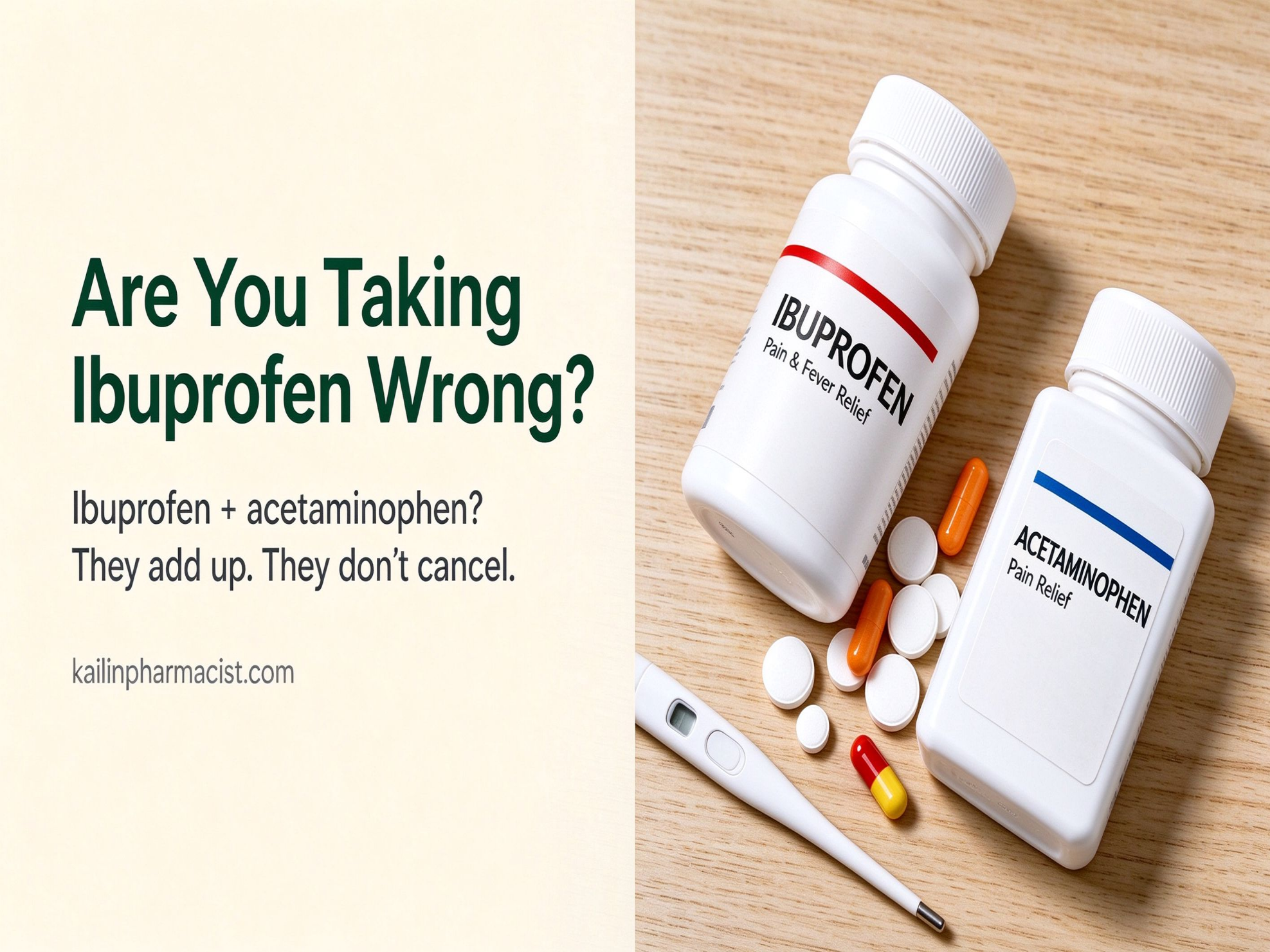
I ran into a colleague in the ER the other night. He was the one on the drip, not the one hanging it.
He looked rough, so I asked.
A cold, he said. A fever that climbed to 103°F and wouldn’t break. He’d taken ibuprofen first, waited, and nothing moved. So he added acetaminophen on top. Somewhere in that long feverish night — chills, sweat, half-awake — he took a few more of each. He couldn’t tell me how many. That’s how those nights go.
By morning, the bloodwork came back wrong. Numbers that should have been boring weren’t. That’s what finally scared him into a bed.
Here’s the part I keep coming back to: he’s a medical professional. He knows both drugs by name. He’s read the labels. And it still happened to him.
Which means it can happen to anyone. So let’s talk about what actually went wrong — because it wasn’t the fever. It was one small, reasonable-sounding decision: “It’s not working, I’ll add the other one.”
First, two numbers
Americans use more than 25 billion doses of acetaminophen a year. Add NSAIDs — the class ibuprofen (Advil, Motrin) belongs to — and the count climbs by roughly another 30 billion doses.
Big numbers are hard to feel. Here’s a smaller one: together that works out to roughly 160 doses of these two medicines for every person in the country, every year — doses sold, not necessarily swallowed. They are the two most common drugs in your cabinet, by a wide margin.
And the uncomfortable part: acetaminophen is the leading cause of drug-induced acute liver failure in the United States — and in the largest U.S. case series, nearly half of those cases were accidental overdoses. Ibuprofen is one of the medicines most often involved when people end up in the ER for a drug problem — and most of those trips aren’t deliberate. They’re ordinary doses that quietly added up.
So — back to my colleague, and the night that added up.
These two drugs are not the same
This is the first thing people get wrong, and everything else follows from it.
Ibuprofen is an NSAID — a nonsteroidal anti-inflammatory drug. It blocks an enzyme called COX, which the body uses to make prostaglandins, the chemicals behind fever, pain and inflammation. So ibuprofen does three jobs at once: it lowers fever, eases pain, and calms inflammation. That last one is why it helps a sprained ankle, a sore back, a bad period — and why it’s the better pick when your fever comes with aching muscles.
Acetaminophen (Tylenol, paracetamol) works mostly in the brain and spinal cord, not in inflamed tissue. It brings down fever and eases pain, but it does almost nothing for inflammation. It’s gentler on the stomach. And it has one hard limit: your liver can only process so much of it.
Two drugs, two jobs, two different danger zones. Remember that — it matters in a second.
Can you take them together? Yes — but “together” has rules
This surprises people: combining them is not a mistake. Done right, it’s actually a good move.
Because they work on different pathways, alternating them can control fever and pain better than either one alone. What the guidelines do not do is bless the switch as a routine answer to a fever that won’t come down. The American Academy of Pediatrics notes that combining the two lowers fever more than either drug alone, then warns in the next breath that the extra complexity is exactly what leads to dosing errors — and that the goal is a comfortable child, not a normal number on the thermometer. In an ER, alternating under supervision is routine. At home at 2 a.m., it’s where people lose count.
The mistake isn’t combining them. The mistake is combining them without keeping score.
Here’s what “done right” looks like:
- Pick a schedule and write it down. Ibuprofen every 6–8 hours. Acetaminophen every 4–6 hours. Note the drug, the dose, and the time — on your phone, on the back of an envelope, anywhere. Fever brains forget. That’s not a character flaw; that’s the fever.
- Never double up on the same drug. Ibuprofen and naproxen are both NSAIDs — taking both is just a bigger dose of the same idea. Same story with acetaminophen sitting in two different products.
And that last point deserves its own warning.
How many ibuprofen a day — and how many acetaminophen?
Over the counter, ibuprofen is a 200 mg tablet. The Drug Facts panel says one tablet every 4 to 6 hours while symptoms last, and no more than 6 tablets in 24 hours — that’s 1,200 mg a day. Prescription ibuprofen goes higher, up to 3,200 mg, but that number belongs to a doctor who is watching you, not to a shelf.
Acetaminophen has a higher ceiling and a harder edge. The FDA sets the adult maximum at 4,000 mg in 24 hours. Plenty of extra-strength products print a lower limit of 3,000 mg on their own labels, so read the box you actually bought. Either figure is a ceiling, not a target — and past it, the liver is what pays.
The hidden trap: acetaminophen is everywhere
Name a cold medicine. DayQuil. NyQuil. Theraflu. Most multi-symptom cold products contain acetaminophen — sometimes sitting on the same shelf, right next to the word Tylenol.
So a person can take a fever reducer, then take a cold syrup “for the congestion,” and end up taking acetaminophen twice without meaning to. Nobody double-doses on purpose. It happens because the same drug hides in boxes with different names.
(I made a one-page chart of every common U.S. cold, flu and pain medicine — one row each — so you can see where the same drug is hiding in two different boxes. It’s free; more on that at the end.)
If you want the chart and the rest of these checks, subscribe — one email a week, no ads.
What my colleague’s bloodwork was actually showing
Now you’ll understand the chart he was staring at.
When these drugs tip over into too much, the test results tell a very specific story — and it’s almost never the thing people expect.
- Acetaminophen over the line attacks the liver. So the labs show liver enzymes — ALT and AST — climbing, sometimes to many times the normal range. Bilirubin rises (that’s what turns skin and eyes yellow). And the clotting time (PT/INR) can stretch, because the liver makes the proteins that let blood clot.
- Ibuprofen over the line attacks the kidneys and the stomach. The kidney numbers — creatinine and BUN — climb. Stomach bleeding shows up as a falling hemoglobin on a blood count. Very high doses can also throw off the body’s acid balance.
- Together, in someone already wiped out by illness and barely drinking, the two effects can pile onto each other — dehydration plus two drugs is a rough combination for kidneys that are already working hard.
One thing worth saying plainly: this isn’t the “blood count” people picture when they say their numbers looked off. These drugs don’t mainly scramble your white cells or platelets. They hit the liver and the kidneys — and those are the numbers that go sideways.
In my colleague’s case, several values were off. Nothing catastrophic — but off, all at once, and frightening enough that he stopped guessing and got help. He did the right thing.
Should you take ibuprofen with food?
If ibuprofen upsets your stomach, take it with food or milk. That is the label’s own instruction, and it does ease the burning.
Don’t hear that as protection, though. Food slows absorption, so the dose arrives a little later — it doesn’t stop an NSAID from irritating the stomach lining or from causing a bleed. If you take a blood thinner, have had an ulcer, or are over 60 and reaching for it several days running, the food is not the fix. Asking first is.
Who should be extra careful with ibuprofen
Ibuprofen is safe for most healthy adults. But it’s the wrong drug for some people, and they often don’t know it. Be careful — or ask first — if you:
- Have ever had a stomach ulcer or bleeding in the gut
- Have kidney disease, or a single kidney — regular NSAID use can damage the kidneys
- Have heart failure, or poorly controlled blood pressure
- Take a blood thinner (warfarin, apixaban, and others)
- Have asthma that gets worse with aspirin or NSAIDs
- Are in the third trimester of pregnancy
- Are older and on several medicines at once
Acetaminophen has its own caution list: heavy alcohol use, existing liver disease, or eating very little for several days in a row all raise the risk.
What to actually do when the fever won’t quit
Here’s the honest part nobody likes to hear: a fever is not the enemy. It’s your immune system running hot on purpose. The goal isn’t to force the number back to normal — it’s to keep the person comfortable and safe.
So:
- Treat how the person feels, not the number on the thermometer.
- Keep fluids going. That matters more than the exact drug — dehydration is what makes most of these situations dangerous.
- If you’re combining, write down every dose. If you can’t remember whether you took one, don’t take another “just in case.”
- Get help if: a fever lasts more than 3 days, won’t come down at all, or comes with a stiff neck, confusion, a rash, trouble breathing — or you simply can’t keep fluids down.
And the last one, which is the whole point of this post:
If a medicine “isn’t working,” the answer is almost never “take more of something else.” It’s to slow down, look at what you’ve already taken, and ask why.
My colleague went home fine. The fever broke on its own, the way fevers do. The scariest part of his week wasn’t the virus. It was the night he lost count.
If you want the bigger picture — what actually helps a cold and what’s still just folklore — start here: What Actually Works for a Cold? And if you can’t tell whether it’s a cold or the flu, that first 48 hours changes how you treat it: Cold or Flu? The First 48 Hours.
One more thing before you go: what’s the medicine mistake you’ve seen someone make — or made yourself? Hit reply and tell me. I read every one, and it often becomes the next post.
And if this helped, send it to the person in your house who reaches for the second box at 2 a.m. It does more good in their phone than in yours.
— Lin Kai, Licensed Pharmacist (China), 17 years behind the hospital pharmacy counter
Related: what Chinese families actually do when the fever hits — Do Chinese People Take Tylenol?
P.S. I made a one-page chart of every common U.S. cold, flu and pain medicine — one row each — so you can spot the same drug hiding in two different boxes. Subscribe for free and I’ll send it to you.
Sources
- U.S. Food and Drug Administration. “Acetaminophen: Avoid Too Much.” fda.gov
- U.S. Food and Drug Administration. “Don’t Overuse Acetaminophen.” fda.gov
- DailyMed (U.S. National Library of Medicine). “Ibuprofen 200 mg tablet — Drug Facts.” dailymed.nlm.nih.gov
- DailyMed. “Motrin (ibuprofen) tablets — Prescribing Information.” dailymed.nlm.nih.gov
- Larson AM, et al. “Acetaminophen-induced acute liver failure: results of a United States multicenter, prospective study.” Hepatology. 2005;42:1364-72. PubMed
- “Confusion: Acetaminophen Dosing Changes Based on NO Evidence in Adults.” PubMed Central. PMC3585765
- Sullivan JE, Farrar HC; American Academy of Pediatrics. “Fever and Antipyretic Use in Children.” Pediatrics. 2011;127(3):580-587. PubMed
- National Institute of Diabetes and Digestive and Kidney Diseases. “Preventing Chronic Kidney Disease.” niddk.nih.gov
Dosing mistakes and label wording are two different problems — how a label review would judge those claims.
Leave a Reply