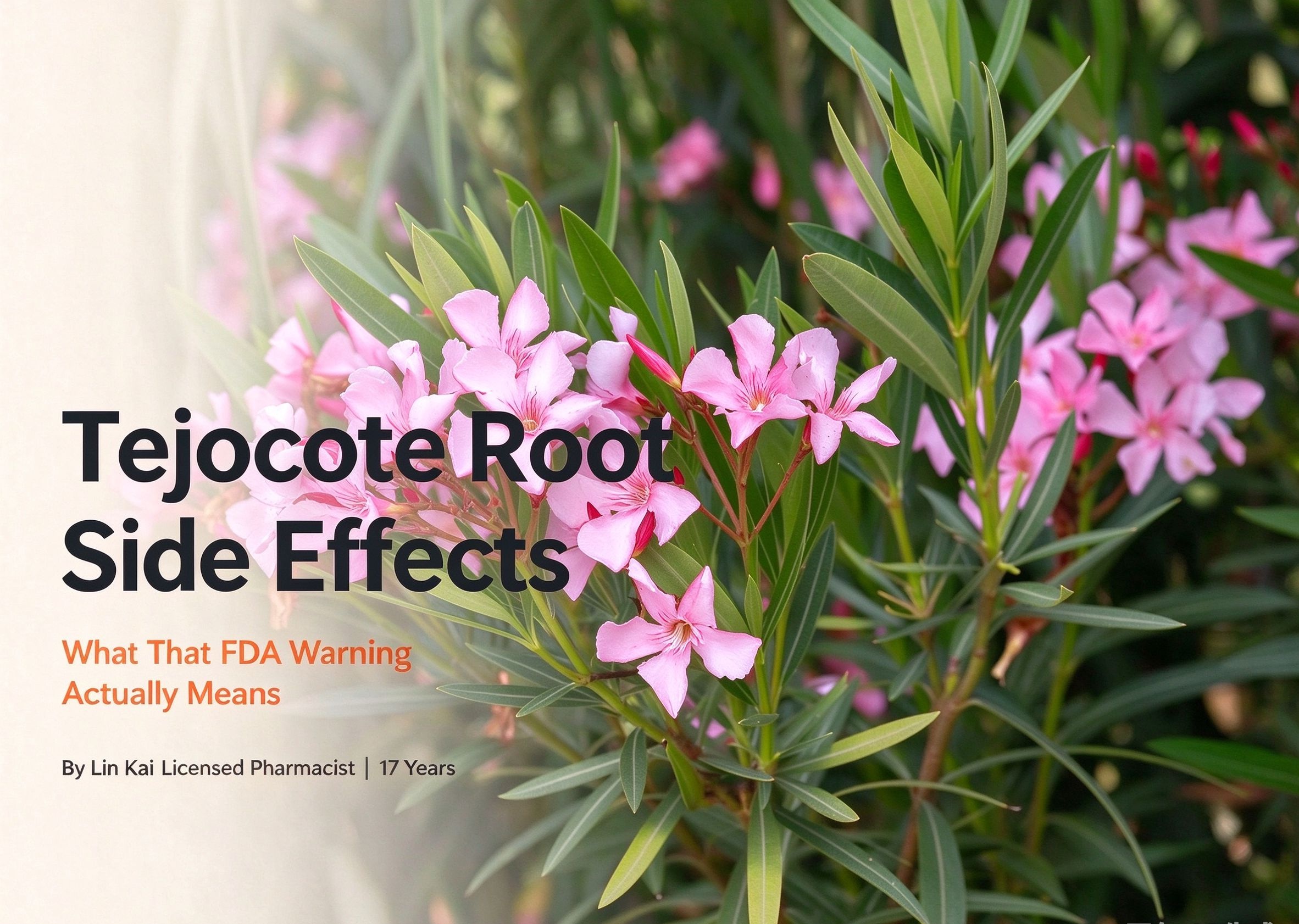
And the Chinese plants that can do exactly the same thing
By Lin Kai, Licensed Pharmacist (China) — 17 years in hospital pharmacy
At lunch, my old friend Andy Lei messaged me a link and one line: “Is this real?”
He had been trying to lose weight. Some algorithm had found him at exactly the right moment, with a headline about the FDA warning on toxic weight-loss supplements.
I didn’t answer right away. Seventeen years of hospital pharmacy have taught me that anything arriving as a screenshot needs to be traced back to the source first.
So I traced it. The story was real.
It was also older than it looked. The screenshot was one update in a running story: the FDA has been widening this same alert since 2023, and the version he saw was from September 2026.
What kept my attention wasn’t how fresh the news was. It was the ingredient the warning keeps returning to: tejocote root, the Mexican hawthorn root sold for years as a “natural” weight-loss remedy. In Chinese-speaking markets it usually goes by 墨西哥根 (mo-xi-ge-gen).
What is tejocote root?
Tejocote is the fruit of the Mexican hawthorn tree. Its root has a long history in Mexican folk medicine as a weight-loss remedy, and that reputation is what built the global market for it.
The root itself is not the main problem. The problem is that what’s in the bottle is often not the root.
What did the FDA actually say?
The alert is not one announcement. It’s a case file that has been open for three years:
- 2023 — CDC testing reported that nine of ten products labeled as tejocote contained yellow oleander instead of the root.
- January 2024 — The FDA issued its formal safety alert after the same substitution turned up in the US market.
- August 12, 2026 — Three more products were added: Slim Elixir, D Magic Plus, and B. Magi, all sold by Suerte Y Salud LLC.
- September 17, 2026 (most recent) — Three more: Niwali Tejocote Pieces, Niwali Tejocote Capsules, and Easy Forte Natural Fiber. The FDA table now lists 28 products.
So the accurate sentence is not “the FDA issued a warning in August 2026.” It is “the FDA widened its warning again, twice, in the last two months.” A lot of outlets got that wrong, and the difference matters.
Source: U.S. FDA, FDA Issues Warning About Certain Products Containing Toxic Yellow Oleander, page last updated September 22, 2026; the most recent products were added September 17, 2026. FDA safety alert page
One detail that changes the advice
Easy Forte Natural Fiber is sold as a fiber supplement. Its label never mentions tejocote. It still tested positive for yellow oleander.
That single line dismantles the most common piece of consumer advice there is: “just read the label.” Checking for the word “tejocote” no longer tells you whether a product is safe. Some bottles never said it in the first place.
Why would a “natural” root contain poison?
Yellow oleander is an ornamental plant. Every part of it carries cardiac glycosides — the same class of compounds as digoxin, working on the same target in heart muscle.
There is a story circulating online that explains the adulteration this way: cardiac glycosides suppress appetite and speed up metabolism, so the products “work.”
That story is false.
Cardiac glycosides do neither. People lose weight on these products because they are poisoned — nausea, vomiting, diarrhea, and no appetite, on top of dehydration from fluid loss. That is not fat loss. That is the body raising an alarm.
What happens if you take it?
| What you feel | What it may mean |
|---|---|
| Palpitations, irregular heartbeat | Possible cardiac glycoside toxicity |
| Dizziness, nausea, vomiting, abdominal pain | Common poisoning signs |
| Unusually slow pulse | Warning sign — seek care |
| Vision tinted yellow or green | Classic cardiac glycoside sign |
| Chest tightness, fainting | Emergency — get help now |
If any of these appear: stop the product, get medical attention, and bring the packaging. People often throw the bottle away before they reach the hospital, which throws away the single most useful clue the treating team has.
If you’d rather hear about the next recall from a pharmacist than from a headline, leave your email here.
Is this only an American problem?
No. Cardiac glycoside poisoning has a long domestic history in China, and the route in is almost always the same: a folk remedy, or a case of mistaken identity.
Oleander (Nerium oleander). Planted along roads in both northern and southern China, toxic in every part. Folk practice uses the leaves boiled in water for cough, asthma, and skin conditions. Every year people end up in emergency departments because of it.
Heartbreak grass (Gelsemium elegans). The one people in Guangdong should know best. It gets mistaken for five-finger fig root or honeysuckle, goes into a pot of soup, and that is the end of the story.
Aconite (Aconitum; fuzi, chuanwu, caowu). Common in homemade medicinal liquor and stews. Aconitine goes straight for the heart.
None of these need a large dose. One wrong meal is enough.
What belongs in a formula — and what never does
This is where a lot of well-meaning advice goes wrong. “Chinese medicine is toxic” is not a useful conclusion, because it flattens a real distinction.
Aconite does belong in formulas. Sini Tang, Zhenwu Tang, Fuzi Lizhong Wan, Xiaohuoluo Dan, Wutou Tang — all of them rely on prepared fuzi, chuanwu, or caowu to restore yang, disperse cold, and stop pain. They are used safely under three conditions: processed, prescribed by a physician, dosed precisely. The poisonings come from the other route — raw, homemade, overdosed, or steeped in alcohol.
Oleander and yellow oleander never belong in a formula. They appear in no legitimate prescription. They show up only in folk remedies: leaves boiled for cough, for wheezing, for skin problems. That is where the poisonings come from.
Heartbreak grass isn’t medicine at all. It’s a misidentification. One mistake, one life.
The line is not “herbs are dangerous.” It’s this: processed, prescribed, and dosed is medicine; self-picked, self-brewed, and hearsay is risk.
How do you protect yourself?
- Skip anything promising rapid fat burn, overnight slimming, or “melt away” results. Real weight loss doesn’t move that fast.
- Don’t assume a label that never says “tejocote” is safe. The September update added a fiber supplement that never mentioned it.
- Palpitations, dizziness, or vomiting after a weight-loss supplement: stop, seek care, bring the packaging.
- Don’t accept “all natural” as proof of safety. Nicotine is natural. Arsenic is natural. Oleander is natural.
If you sell supplements
The exposure isn’t only on the consumer side. An FDA public warning, a delisted product, a restricted seller account — all of these are live possibilities. Verifying botanical ingredients and label compliance before listing costs far less than fixing it afterwards.
Related reading
- How supplements are regulated, and how to choose one: The Pharmacist’s Complete Guide to Dietary Supplement Safety
- How to spot an exaggerated ad in ten seconds: Can You Spot a Bad Supplement Ad? 8 Red Flags
- The specific traps in common herbs: 3 Popular Herbal Supplements: A Pharmacist’s Quick-Look Guide
- Why “it’s natural” is not a safety claim: Does Echinacea Work for Colds?
Appendix: the five formulas mentioned above
Sini Tang (Four-Yang Reversal Decoction, Shanghan Lun) — prepared fuzi, dried ginger, licorice. Restores yang and rescues collapse: cold limbs, chills, watery diarrhea, a pulse almost too faint to feel. The classic emergency formula for a body that has run out of heat.
Zhenwu Tang (True Warrior Decoction, Shanghan Lun) — fuzi, poria, baizhu, peony, fresh ginger. Warms yang and moves water: edema, scanty urine, heavy limbs, palpitations, dizziness. Not “internal heat” — fluid that won’t drain.
Fuzi Lizhong Wan (Aconite Stomach-Regulating Pill, Taiping Huimin Hejiju Fang) — prepared fuzi, codonopsis, baizhu, dried ginger, licorice. Warms the middle and strengthens the spleen: cold, aching stomach, vomiting, diarrhea, cold hands and feet. One of the most commonly dispensed aconite-containing patent medicines.
Xiaohuoluo Dan (Minor Channel-Opening Pill, Taiping Huimin Hejiju Fang) — prepared chuanwu and caowu, arisaema, earthworm, frankincense, myrrh. Dispels wind-cold, dries dampness, moves blood, stops pain: cold, painful joints, numbness, limited movement. Contains both aconites — contraindicated in pregnancy, not for prolonged or high-dose use.
Wutou Tang (Aconite Decoction, Jingui Yaolue) — chuanwu, ephedra, astragalus, peony, licorice, honey. Warms meridians, disperses cold, unblocks painful obstruction: severe cold-damp joint pain that won’t bend. The original decocts chuanwu with honey to reduce toxicity — the textbook example of using poison to treat pain, and strictly a physician’s call.
All five contain fuzi, chuanwu, or caowu. They work under the same three conditions, every time: processed, prescribed, and dosed.
Sources
- U.S. FDA. FDA Issues Warning About Certain Products Containing Toxic Yellow Oleander. Page last updated September 22, 2026.
- CDC. Notes from the Field: Online Weight Loss Supplements Labeled as Tejocote (Crataegus mexicana) Root, Substituted with Yellow Oleander (Cascabela thevetia) — United States, 2022. MMWR Morb Mortal Wkly Rep. 2023;72(37):1016–1017.
- Poison Help (HRSA), 24-hour US poison center line: 1-800-222-1222.
- Shanghan Lun (Treatise on Cold Damage), Han dynasty, Zhang Zhongjing.
- Jingui Yaolue (Essentials of the Golden Cabinet), Han dynasty, Zhang Zhongjing.
- Taiping Huimin Hejiju Fang (Formulary of the Pharmacy Service for Benefiting the People of the Great Peace), Song dynasty.
The label on the bottle is usually where this case starts. If you want the rules that decide whether one passes, here is how a US supplement label actually has to read.
This article is for education only and is not medical advice. For your own situation, speak with a qualified clinician.
Leave a Reply