By Lin Kai, Licensed Pharmacist (China) · 17 years in hospital pharmacy
Health education only — not medical advice. See a licensed clinician for your own symptoms.
Short answer: no. Dampness does not turn into fat, and clearing dampness does not make anyone thin. What happens is simpler and more disappointing — coix seed water and similar products move water, and water is what the scale was measuring in the first place. Two pounds of water comes off in days and comes back in three. Fat needs a calorie deficit, which no tea provides. If you want the background first, what dampness actually is is the place to start. The rest of this page is how to tell which one you are actually carrying, why people with dampness often do gain weight anyway, and what four weeks can realistically change.
A woman in her forties opened with this: “I lost two pounds on coix seed water. I stopped for three days and it all came back. Is my constitution just stubborn?”
No. What you lost was never fat. It was water. And that water was always going to come back.
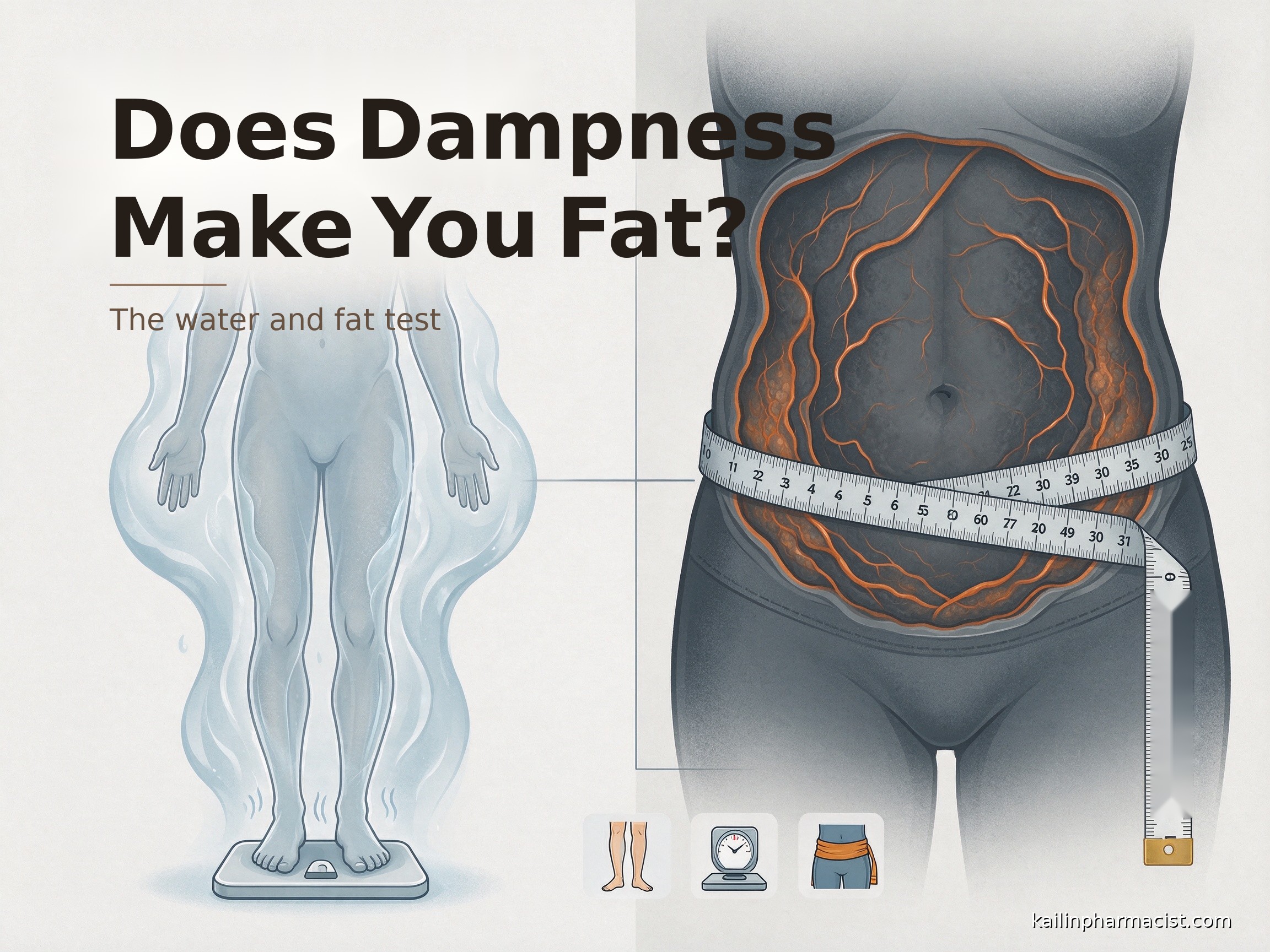
First: is it water, or is it fat?
These get blended into one sentence — “I have dampness so I’m fat” — but they need opposite handling.
Test one: press your shin. Thumb on the bone edge of the lower leg, press for three seconds, release. A pit that stays for a while is pitting edema: that is water, and it needs heart, kidney and liver checked. If it springs straight back and feels firm, it is fat or muscle. Note that older people who stand a lot get mild ankle swelling that resolves overnight; only persistent, obvious pitting needs investigation.
Test two: morning versus evening weight. Weigh after emptying your bladder in the morning, then again before bed. A difference of one to two kilos across a day is normal — food, drink, salt. If it regularly runs over two kilos and falls back after a night’s rest, that is fluid shifting, not fat accumulating.
Test three: waist measurement. Around the navel, do not suck in. If your weight is flat but your waist keeps growing, that is fat, and specifically visceral fat. Waist tells you more than weight does.
Three tests, and you know whether you are chasing water or fat. They are not the same job. And if you have not yet worked out whether you run cold or hot, that comes first — the same tea helps one and hurts the other.
Why people with dampness really do gain weight
Not because dampness becomes fat. Three lines tangle together.
Sitting. Ten hours in a chair and both muscle mass and daily movement fall. Calories that come in do not get used, and they go to the abdomen. Chinese medicine calls it jiu zuo shang rou — sitting damages the flesh. Modern language calls it loss of muscle and worsening insulin sensitivity. Same observation, two vocabularies.
Sugar. Milk tea, sweet drinks, pastries, refined grains. Blood glucose spikes, insulin follows, fat storage opens and fat release closes. This is why plenty of people eat “not much” and still gain: it is not the total, it is the type that keeps the body in storage mode.
Sleep. Short sleep raises ghrelin and lowers leptin the next day, and you want high-sugar, high-fat food. That is not weak willpower, that is hormones pushing. And late nights generate dampness on their own, as covered earlier — two lines running at once.
All three point to the same place: the abdomen, which is exactly where Chinese medicine says phlegm-damp collects. So “people with dampness have big bellies” holds up as an observation. The reason is not that dampness turns into fat; it is that the same habits produce both.
One sentence to keep straight: this is correlation, not causation. Dampness is not the cause of obesity, and clearing dampness will not make you thin.
Why coix seed water only works for two weeks
The mechanism is simple: coix seed moves water, not fat.
It helps the body shed some retained fluid. The scale drops, because a kilo of water is a kilo on the scale, and two days is enough.
Three things bring it back:
- You are still drinking iced drinks and eating salty food. Water leaves and water enters, and the level in the pool does not change.
- Water is not fat. Fat needs a calorie deficit. Coix seed water cannot create one.
- Long-term use makes a cold constitution weaker. Coix seed is cool by nature, as covered in the earlier pieces; a weaker system burns less, so weight is easier to gain, not harder. What coix seed does and does not do is set out in full in the previous piece.
So “two pounds lighter in two weeks” is real, and so is the return. Nothing lied to you. It just was not solving the problem you cared about.
Five ways money disappears and nothing changes
1. Dampness tea plus meal replacements. Meal replacements crash your intake and the scale drops fast — water and glycogen, not fat. Resume eating and it all returns, sometimes heavier. The tea adds nothing to this.
2. Juice cleanses and fasting retreats. Juice is sugar. Fasting is usually followed by rebound eating. Both score negative on weight, and cold plus high sugar is exactly the combination that generates dampness. You are pulling in two directions at once.
3. Sweat suits, saunas, plastic wrap. Water leaves, two glasses bring it back, and heavy sweating consumes qi and damages yin.
4. Foot patches that claim to draw out fat. The black color is powder reacting with sweat. It has nothing to do with fat metabolism.
5. Moxibustion and massage only, with no change to food. In fairness: moxibustion and tuina do relieve bloating, heaviness and feeling cold for some people, and using them as supportive care is reasonable. But no external treatment replaces a calorie deficit. Do moxibustion every week and keep the milk tea and fried chicken, and the scale will not move.
The test is simple: anything that promises weight loss without changing food or activity is selling, not treating.
When weight needs a doctor, not a tea
If your weight is climbing and any of these apply, get checked before you try to fix it yourself:
- Cold, tired, dry skin, constipation — thyroid function.
- Puffy eyelids in the morning, frothy urine, reduced urine output — kidney function and urinalysis.
- Short of breath on exertion, breathless lying flat, swollen ankles — heart function.
- Women: irregular periods, acne, excess hair, weight concentrated at the waist — screen for PCOS and insulin resistance.
- Weight dropping quickly without trying — the opposite direction, and more urgent.
Any one of these makes “losing weight” a secondary question. Find out what state the body is in first.
What four weeks can do
This is a routine to adjust habits. It is not a weight-loss prescription and it does not promise a number on the scale. If any item in the list above applies to you, see a doctor before starting.
Week one: look, don’t change. Weigh yourself at a fixed time, measure your waist, write both down. Note how many sweet drinks you had, how many hours you sat, what time you went to bed. See yourself before you touch anything.
Week two: cut three things. Iced drinks, sugary drinks, late-night eating. Only those. Most people drop one to two kilos this week, mostly water — do not celebrate yet, but the body does feel lighter.
Week three: add two things. Thirty minutes of brisk walking a day, and bed before eleven. These are the floor of metabolism, and they hold up better than any supplement.
Week four: add one strength session. Twice a week, twenty minutes: squats, wall push-ups, resistance bands. Muscle is among the most reliable ways to raise resting metabolism over time, and the thing dampness marketing never mentions.
Four weeks later you may be two or three kilos down, or one. What you built is something you can keep using, not a tea you drink for two weeks and rebound from.
One last thing
Dampness and fat are neighbours, not parent and child.
They live on the same street: sitting, sugar, late nights. Change the street and both shift. Knock only on the door marked “dampness” and the other door stays shut.
So do not ask how to clear dampness so you can get thin. Ask: how did the last few years turn me into this weight? Answer that, and both problems move. Skip it, and every tea lasts two weeks.
Sources
- Guangdong Provincial Administration of Traditional Chinese Medicine, “多喝凉茶、多吃寒凉祛湿食材、大量发汗排湿……这些祛湿盲区要知道”, 28 May 2026 (in Chinese): https://szyyj.gd.gov.cn/zyyfw/ysbj/content/post_4903183.html
- Same authority, “初春祛湿,应选择温和的食材”, 10 Feb 2023 (in Chinese): https://szyyj.gd.gov.cn/zyyfw/ysbj/content/post_4092692.html
- Chinese Pharmacopoeia, coix seed (薏苡仁): cool by nature; drains dampness and supports the spleen; use with caution in pregnancy. Summarised from the Pharmacopoeia entry.
Health education only. It is not medical advice, not a diagnosis, and not a prescription. It does not promise weight loss. If you have an existing condition or take prescription medicines, check with your doctor or pharmacist first.
If this was useful, one email a week, no more than that.
Leave a Reply