Most acute sinus infections are caused by viruses. In national estimates, the viral share runs above 90%. Antibiotics do nothing to a virus.
They help in three situations only:
- Symptoms have gone more than ten days without improving.
- The illness starts severe — high fever together with thick discharge or facial pain, lasting three to four days.
- Symptoms improve, then get worse again.
If none of those apply, wait.
That framework comes from the 2012 guideline by the Infectious Diseases Society of America, and it still holds. The World Health Organization’s Essential Medicines List Antibiotic Book puts it more bluntly: yellow or green nasal discharge on its own is not a sign of bacterial infection, and it is not a reason to prescribe.
What a sinus infection actually is
The sinuses are air-filled spaces inside the bones around your nose. Four pairs, one on each side: maxillary, ethmoid, frontal, sphenoid. They are supposed to be empty. Each drains through a small opening into the nasal cavity, and the lining keeps producing mucus that flows out that way — humidifying the air you breathe, filtering it, and keeping your head from being heavier than it needs to be.
That design is also the problem. The openings are small.
When the nasal lining swells, those openings close first. Mucus can’t get out, air can’t get in, and what’s left inside is a warm, wet, nutrient-rich box. So the disease isn’t really “an infection in the sinus.” It’s a blocked drain, and then inflammation behind it.
Why it’s so common
Because the step before it is a cold, and colds are everywhere.
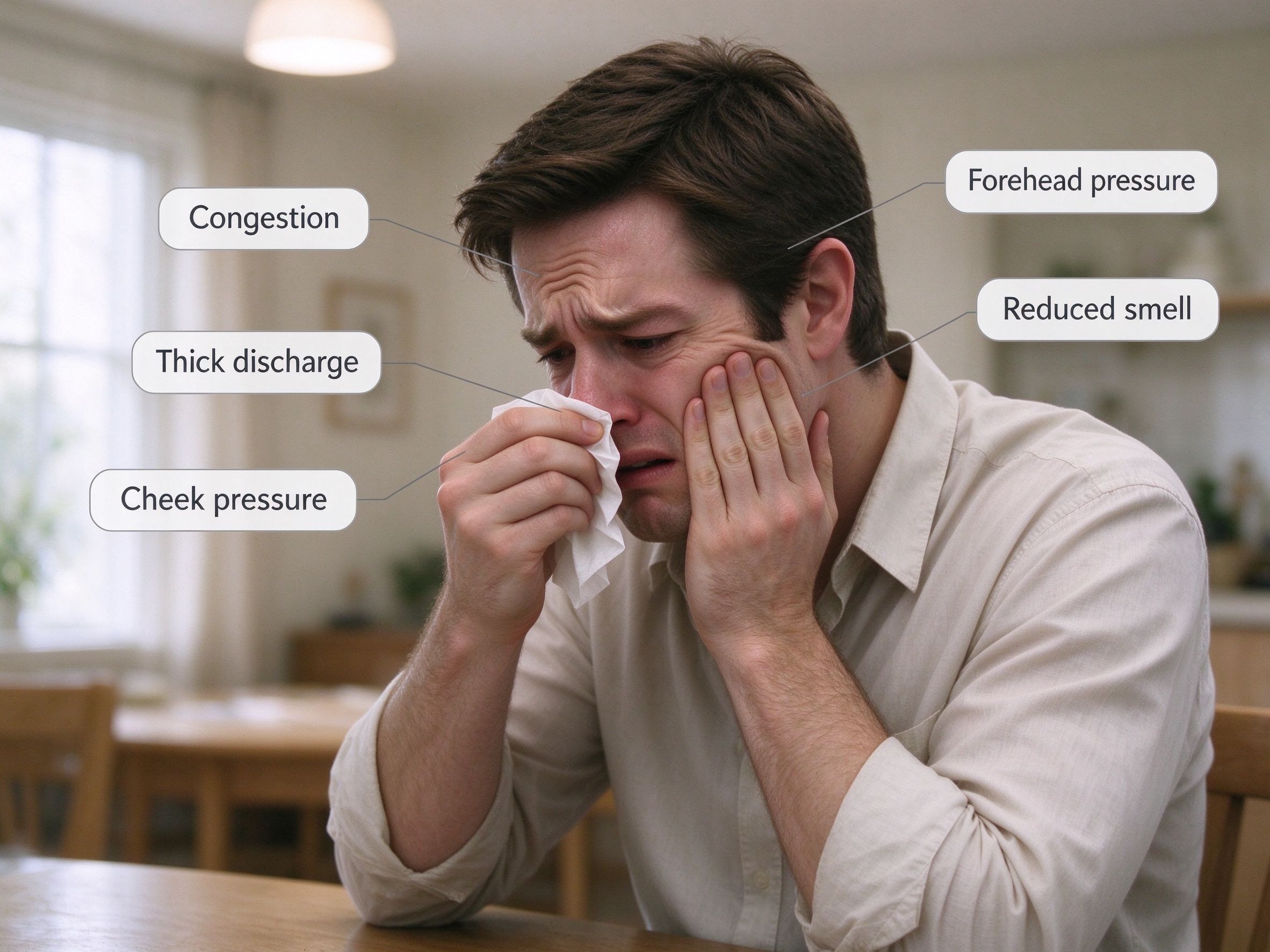
Adults get two or three a year; children get more. Every cold swells the nasal lining and shuts those small openings for a while. Most people drain, open up, and recover. Some stay blocked long enough to develop the familiar set of symptoms — congestion, thick discharge, pressure over the cheeks or forehead, a dulled sense of smell, all of it worse when you bend forward.
And the same reflex shows up one step earlier: most colds don’t need antibiotics either, and the reasoning is identical. It just gets applied less often.
As for why antibiotics get used so much: a US outpatient study found that roughly seventy percent of visits for chronic rhinosinusitis end with an antibiotic prescription, and the figure is higher for acute cases. A lot of prescriptions go out before anyone has sorted out whether bacteria are involved.
How many people this affects
One clarification first. There is no single global count for acute sinusitis. Almost every national figure you’ll see is for chronic rhinosinusitis — symptoms lasting twelve weeks or more. Chronic disease is built out of repeated acute episodes, so the numbers still tell you how widespread the problem is.
China: 8%. That comes from a multicenter survey across seven representative cities, face-to-face questionnaires with 10,636 people, scored against the European rhinosinusitis criteria. Extrapolated nationally, that is more than a hundred million people. The figure appears in both the 2018 and 2024 editions of China’s chronic rhinosinusitis guideline. City-level rates vary widely — Changchun 10.23%, Wuhan 9.76%, Urumqi 9.24%, Chengdu 9.38%, Guangzhou 8.44%, against Beijing at 4.18% and Huai’an at 4.56%.
United States: 11.6%. The CDC’s National Health Interview Survey, 2018 data, puts the number of adults ever diagnosed with sinusitis at about 28.9 million. In the same year there were roughly 2.7 million physician office visits with chronic sinusitis as the primary diagnosis, and about 234,000 emergency department visits (National Hospital Ambulatory Medical Care Survey, 2018).
For comparison: Europe 10.9%, South Korea 6.95%, São Paulo 5.51%.
China sits slightly below Europe and the US, above Korea and Brazil. Put against a population of 1.4 billion, that’s over a hundred million people — which is why this is a pharmacy disease, not a specialist’s disease.
One quick note before the decision part. I write this from a hospital pharmacy in China, one question at a time — no supplement pitches, no product links. If you want the next one when it lands, leave your email below.
Why the color of your mucus proves nothing
The color does not tell you what’s causing it. Here’s what actually turns it yellow.
Neutrophils — white blood cells — move into the nasal lining to fight whatever is there, then die and release enzymes that carry color. Viruses trigger exactly the same response. So yellow discharge on day three of a cold is the expected course of a viral illness, not a signal that bacteria have moved in.
Controlled comparisons have looked at this directly: green discharge turns up in viral and bacterial groups at roughly the same rate, both a bit over half. You cannot separate them by looking.
What does separate them is time and trajectory — which is why the first question a clinician asks is “how many days,” never “what color.”
Three time points that decide it
One: more than ten days without improvement. Viral illness usually turns the corner in seven to ten days. Still flat on day ten, and bacteria become plausible. Note the wording — not “not fully better yet,” but “not better.” If things are easing day by day, keep waiting.
Two: severe from the start. Fever above 102°F (39°C) together with thick discharge or facial pain, lasting three to four days. That one doesn’t wait for day ten; it goes to a clinician. The combination is what matters — fever alone doesn’t qualify.
Three: better, then worse. Five or six days into a cold, just as it seemed to be lifting, the fever returns, the discharge thickens, the face hurts again. This two-hump pattern, sometimes called double sickening, raises the odds of bacterial infection.
Some guidelines allow a period of observation even when the criteria are met, treating antibiotics as a fallback rather than a reflex, and the 2025 update widened that option. The two approaches genuinely differ. What they agree on is the part that matters: if you haven’t met the criteria, don’t take the drug.
What antibiotics actually buy you
Not much, honestly.
Pooled randomized trials land somewhere around this: for every dozen or two people with acute sinusitis who take an antibiotic, roughly one extra person gets better a little sooner — while the rate of diarrhea and nausea roughly doubles. There is a small gain in clinical improvement, and it is largely canceled out by the adverse effects.
There’s a second bill that doesn’t show up on the receipt. One unnecessary course disrupts gut flora for weeks to months. And if a resistant organism takes up residence in you, the first-line drugs may not work later, when it’s pneumonia or a urinary tract infection and you actually need them.
If you do need one, which one
1. Amoxicillin-clavulanate — first choice. In adults, 875/125 mg twice daily, or 500/125 mg three times daily. Clavulanate is there to cover beta-lactamase-producing Haemophilus influenzae, which plain amoxicillin does not reliably reach.
2. Amoxicillin — reasonable when there are no resistance risk factors. The American Academy of Otolaryngology–Head and Neck Surgery guideline, in both its 2015 edition and the 2025 update, lists amoxicillin with or without clavulanate as first-line for most adults. The logic is to check for resistance risk first and pick the narrower drug when it’s safe to — fewer side effects. That low-risk/high-risk split comes from the 2012 IDSA guideline, and the two do not conflict on this point.
3. Doxycycline — the usual substitute for penicillin allergy. 100 mg twice daily. A fair number of people carrying a “penicillin allergy” label are not actually allergic, but whether you can take it is a clinical call, not a self-assessment.
4. Respiratory fluoroquinolones (levofloxacin, moxifloxacin) — the other route for allergic patients, and it needs a prescriber. They cover broadly and they cost broadly: tendon injury, QT prolongation, chelation with aluminum- or magnesium-containing antacids and with iron. Not something to buy over the counter and start on your own.
5. Six groups who need a different or escalated regimen rather than picking from 1–4 on their own: antibiotics in the past month, recent hospitalization, age 65 or older, children under two, immunocompromised patients, and children in daycare. Resistance rates run higher, and both the drug and the dose change.
On duration, the guidance splits by age: five to seven days for adults, ten to fourteen days for children — two figures from the same guideline covering different populations, not two competing standards.
What to do instead
1. Saline irrigation — the strongest home measure you have. Two or three times a day. The point isn’t to “kill” anything; it’s to clear the openings and let drainage resume. Use sterile, boiled-and-cooled, or distilled water. Never straight tap water. There are US cases of fatal amoebic infection from tap-water rinsing.
2. An intranasal corticosteroid spray (mometasone and similar). It reduces mucosal swelling and holds the openings open. It does not work on the first spray. Give it several consecutive days before deciding it did nothing.
3. Pain and fever relief. Acetaminophen or ibuprofen, by the label and by weight. Facial pressure is often the worst part of the illness. Control that and most people can ride it out.
4. Humidity and position. Keep indoor humidity around 40–60%, and sleep with your head slightly raised so gravity helps drainage. This treats nothing, but it helps you sleep, and sleeping is part of recovering.
Four things I’d hold back on
- Oral decongestants (pseudoephedrine and relatives) — brief relief, at the cost of jitters, raised blood pressure, and poor sleep. A worse trade for anyone with hypertension or heart disease.
- Antihistamines — unless you also have allergic rhinitis, they don’t help sinusitis and they thicken the secretions.
- Steam inhalation — pleasant, thin evidence. Don’t count on it.
- Herbal “nasal clearance” remedies — I saw a great many of these in Chinese pharmacies. They handle symptoms, not infection. They are not a substitute for an antibiotic, and they are not mandatory either.
The same measures carry most of the load for a plain cold as well — what actually works for a cold is not very different from this list.
When to stop waiting and get seen
- Swelling around the eye, a drooping eyelid, blurred or double vision
- Severe headache, neck stiffness, confusion or unusual drowsiness
- Fever that won’t come down over several days, with redness and swelling over the face
- Foul-smelling discharge from one side only — in a child, think foreign body; in an adult, think teeth
- Symptoms that were improving and then reversed course
The first two are signs of orbital or intracranial spread. Those are emergencies, not a “let’s give it two more days.”
The one line worth remembering
Count the days, not the colors. Ten days without improvement, severe from the start, better then worse — any one of those, go get seen. None of them, and it’s saline, a steroid spray, and a pain reliever until the week passes. Save the antibiotic for the time you actually need it.
If this saved you a course of antibiotics you didn’t need, send it to the person in your family who asks for one every time somebody sneezes.
This is general information, not a substitute for being seen. If you’re being treated for a sinus infection, or you have any of the warning signs above, talk to your doctor or pharmacist before starting, stopping, or changing any medicine.
Written in Chinese, brought into English with AI — the experience and the judgment are mine.
Leave a Reply