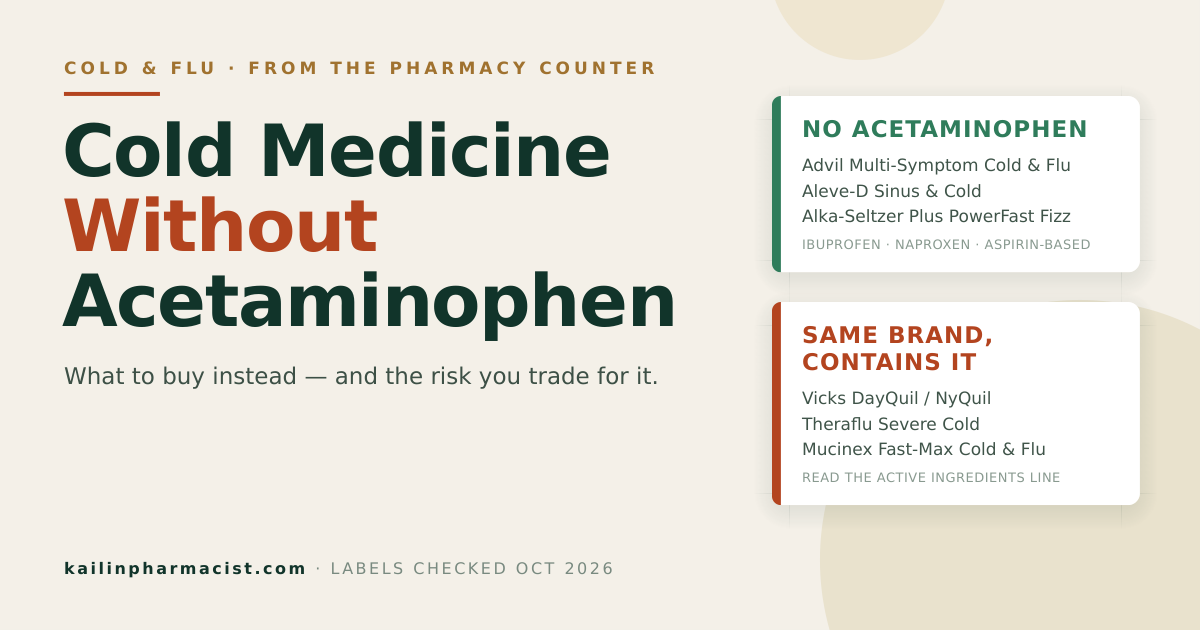
If you need to avoid acetaminophen — because of your liver, because you drink most days, or because a prescription you already take contains it — the short answer is that three families of cold medicine can replace it: ibuprofen combinations, naproxen combinations, and the aspirin-based Alka-Seltzer Plus formulas. Cough and congestion can also be treated on their own, without any pain reliever at all.
The harder part isn’t finding an alternative. It’s that the same brand name can contain acetaminophen in one version and not in another, and the box front rarely makes the difference obvious.
Why people end up looking for this
Four reasons show up again and again.
The first is liver disease. Acetaminophen is handled by the liver, and FDA’s labeling tells anyone with liver disease to ask a clinician before using it. The second is alcohol — FDA’s own wording is that severe liver damage may occur if you have three or more alcoholic drinks per day while using acetaminophen. The third is quieter and more common: a prescription painkiller that already contains acetaminophen, often written as APAP, hydrocodone/APAP, or oxycodone/APAP on the bottle. Add a cold medicine on top and the daily total climbs without anyone noticing. The fourth is simply caution after hearing how much of it is out there — FDA describes acetaminophen as being in hundreds of over-the-counter and prescription products.
That last point is not a slogan. A US Food and Drug Administration review of national databases put acetaminophen-associated overdose at roughly 56,000 emergency department visits and 26,000 hospitalizations per year across the 1990s — figures the agency repeated in later Federal Register notices. In the prospective study covering the same years, acetaminophen accounted for 42% of 662 adults with acute liver failure across 22 US centers — a share that rose from 28% in 1998 to 51% in 2003 — and 48% of those cases were unintentional overdoses (Larson AM, et al. Hepatology. 2005;42:1364–72; data through 2003).
The only line on the box that matters
Turn the box over and find Drug Facts. The section you want is Active ingredients, and you are looking for any of these words: acetaminophen, APAP, or paracetamol. APAP is the abbreviation used on prescription labels; paracetamol is the name used outside the United States. Same drug.
Everything on the front of the box — “cold and flu,” “multi-symptom,” “severe,” “daytime,” “nighttime,” “for people with diabetes” — describes what the product is for, not what is inside it. The diabetes versions of DayQuil and NyQuil are sugar-free versions of a product that still contains acetaminophen.
This one habit catches more people than any other: reading the active ingredients every time, even on a product you have bought before. Formulations change between seasons and between markets.
What actually doesn’t contain acetaminophen
The table below was built by checking current product labels in the National Library of Medicine’s DailyMed database, one variant at a time, in October 2026. Ingredients are listed as they appear on the label. Formulations change between seasons and between markets, so verify the panel on the box in your hand.
| Product (exact variant) | Active ingredients | Acetaminophen? |
|---|---|---|
| Advil Multi-Symptom Cold & Flu | ibuprofen, phenylephrine, chlorpheniramine | No |
| Aleve-D Sinus & Cold | naproxen sodium, pseudoephedrine | No |
| Alka-Seltzer Plus Severe Cold PowerFast Fizz Non-Drowsy | aspirin, dextromethorphan, phenylephrine | No |
| Alka-Seltzer Plus Severe Cold Night PowerFast Fizz | aspirin, doxylamine, dextromethorphan, phenylephrine | No |
| Coricidin HBP Cough & Cold | chlorpheniramine, dextromethorphan | No |
| Coricidin HBP Chest Congestion & Cough | dextromethorphan, guaifenesin | No |
| Mucinex DM | guaifenesin, dextromethorphan | No |
| Mucinex Fast-Max Severe Congestion & Cough | dextromethorphan, guaifenesin, phenylephrine | No |
Now the same brands, other versions — these do contain it:
| Product (exact variant) | Active ingredients |
|---|---|
| Vicks DayQuil Cold & Flu | acetaminophen, dextromethorphan |
| Vicks NyQuil Cold & Flu | acetaminophen, doxylamine, dextromethorphan |
| Theraflu Severe Cold Relief Daytime | acetaminophen, dextromethorphan |
| Mucinex Fast-Max Cold & Flu | acetaminophen, dextromethorphan |
| Alka-Seltzer Plus Cold & Flu | acetaminophen, phenylephrine, chlorpheniramine, dextromethorphan |
| Coricidin HBP Cold & Flu | acetaminophen, chlorpheniramine |
Read those two tables together, because this is the part most online lists get wrong. Alka-Seltzer Plus is not “the aspirin one” — some PowerFast Fizz formulas use aspirin and others use acetaminophen. Coricidin HBP is not “the acetaminophen-free brand” — it was built for people with high blood pressure by leaving out the decongestant, and several of its versions still contain acetaminophen. Any advice organized by brand name rather than by variant will fail you at the shelf.
If you are the kind of person who wants the whole shelf in one place, I keep one-page chart of every common cold medicine — one row per product, one column per ingredient, so you can see at a glance where the same drug is hiding in two different boxes.
The catch: you are trading one risk for another
Ibuprofen, naproxen and aspirin are all NSAIDs, and they are not a free swap. They are hard on the stomach and the kidneys, and they matter in ways acetaminophen does not:
They raise the risk of stomach bleeding, especially with a history of ulcers or with blood thinners. They can reduce kidney blood flow, which is a real problem if you are dehydrated from a fever, or already have kidney disease. Ibuprofen labeling tells you not to use it at 20 weeks of pregnancy or later unless a clinician specifically directs it. It should be avoided after coronary artery bypass surgery. A small number of people with asthma react to aspirin and other NSAIDs. And if you take a daily low-dose aspirin for your heart, adding ibuprofen regularly can interfere with it.
This is where a lot of “just avoid acetaminophen” advice quietly becomes bad advice. Someone with liver concerns and a history of stomach ulcers has now been moved from one problem to a bigger one. If both drugs are off the table for you, the honest answer is that you treat symptoms without a systemic pain reliever: saline spray for congestion, honey for cough in anyone over 1 year (not for infants under 12 months — infant botulism risk), fluids, rest, and a clinician’s advice if fever is high or lasting.
Match the ingredient to the symptom, not to the box
Most people buy a multi-symptom product and take four drugs for one symptom. If your only complaint is a cough, dextromethorphan alone covers it. If it’s congestion, phenylephrine or pseudoephedrine alone. If it’s a runny nose, an antihistamine alone. Deciding what you actually have is cheaper, safer, and easier on your liver than any combination product.
Two practical notes, and the second one is the more useful. Pseudoephedrine sits behind the counter in the US because it can be diverted, and it raises blood pressure — Coricidin HBP exists precisely because that ingredient is left out.
Phenylephrine is the decongestant allowed on the open shelf, and it is the one in most of the acetaminophen-free products above. In November 2024 the FDA issued a proposed order to remove oral phenylephrine from the OTC monograph entirely, after its external advisors voted unanimously that the data do not support that the labeled oral dose works as a nasal decongestant. As of late 2026 that order is still proposed, not final, so the ingredient is still on shelves and still in these boxes. Which means: if your reason for buying Advil Multi-Symptom Cold & Flu is the stuffy nose, you may be paying for an ingredient the FDA has already proposed to remove, on the view that the data do not support the labeled oral dose. A saline or oxymetazoline nasal spray does the job locally, without the argument.
Children and pregnancy
For children, cough and cold combination products are the wrong starting point. Doses are calculated by body weight, not age alone, and as a general rule these products are not used in children under 4 without a clinician’s direction. One point needs saying separately, because two products in the first table are built on aspirin: aspirin should not be given to children or teenagers during a viral illness, because of the risk of Reye’s syndrome. If there is a child in the house, those Alka-Seltzer formulas are not an option.
For pregnancy, the choice belongs with your obstetric clinician. Ibuprofen labeling already tells you to avoid it at 20 weeks or later unless directed, and acetaminophen has its own trimester-specific questions. This is not a decision to make from a blog post.
What I see at the counter
A middle-aged man came up to the pharmacy counter holding a box of Alka-Seltzer Plus Cold & Flu. He told me his liver specialist had told him he needed to avoid acetaminophen entirely. Seeing the Alka-Seltzer Plus brand on the shelf, he assumed every variant used aspirin and would be safe for him. I flipped the box around to the Drug Facts panel and pointed out acetaminophen listed among the active ingredients. Realizing his mistake, he returned that box to the shelf and selected one of the aspirin-only variants instead.
The pattern is almost always the same, though. The person has already done the responsible thing — they read about acetaminophen and the liver, they decided to avoid it, and they picked up something that says “cold and flu” on the front. Nobody told them the fine print sits on the back panel, in a smaller font, under a heading that doesn’t sound important.
The short version
Avoiding acetaminophen is a reasonable decision and it is entirely doable. Do it by reading the Active ingredients line on the back of every box, every time — not by memorizing brand names. If you swap to ibuprofen, naproxen or aspirin, know which new cautions you just picked up, since for some people those are worse than the original problem. And if the reason you’re avoiding acetaminophen is a prescription that already contains it, that is worth a five-minute conversation with a pharmacist before you buy anything: it’s the same conversation as the Tylenol-inside-DayQuil problem, just from the other direction.
If this saved you a walk back to the shelf, send it to the person in your family who buys the cold medicine for everyone.
Sources
- US Food and Drug Administration. Acetaminophen Information (accessed 2026-10-27).
- Nourjah P, Ahmad SR, Karwoski C, Willy M. Estimates of acetaminophen-associated overdoses in the United States. Pharmacoepidemiol Drug Saf. 2006. PMID 16294364.
- Larson AM, Polson J, Fontana RJ, et al. Acetaminophen-induced acute liver failure: results of a United States multicenter, prospective study. Hepatology. 2005;42(6):1364–72. PMID 16317692.
- US Food and Drug Administration. Internal Analgesic, Antipyretic, and Antirheumatic Drug Products for Over-the-Counter Human Use; Proposed Amendment of the Tentative Final Monograph. Federal Register, 2006-12-26 (E6-21855).
- US Food and Drug Administration. FDA Proposes Ending Use of Oral Phenylephrine as OTC Monograph Nasal Decongestant Active Ingredient (proposed order OTC000036, November 2024; still proposed as of 2026).
- National Library of Medicine, DailyMed product labeling, queried 2026-10-27 for each product named in both tables.
By Kai Lin, Licensed Pharmacist (China), 17 years in hospital pharmacy. This is general information from a hospital pharmacist, not medical advice for your situation. If you have liver disease, kidney disease, a bleeding disorder, or take prescription medicine, check with your own clinician or pharmacist before choosing a cold medicine.
Leave a Reply