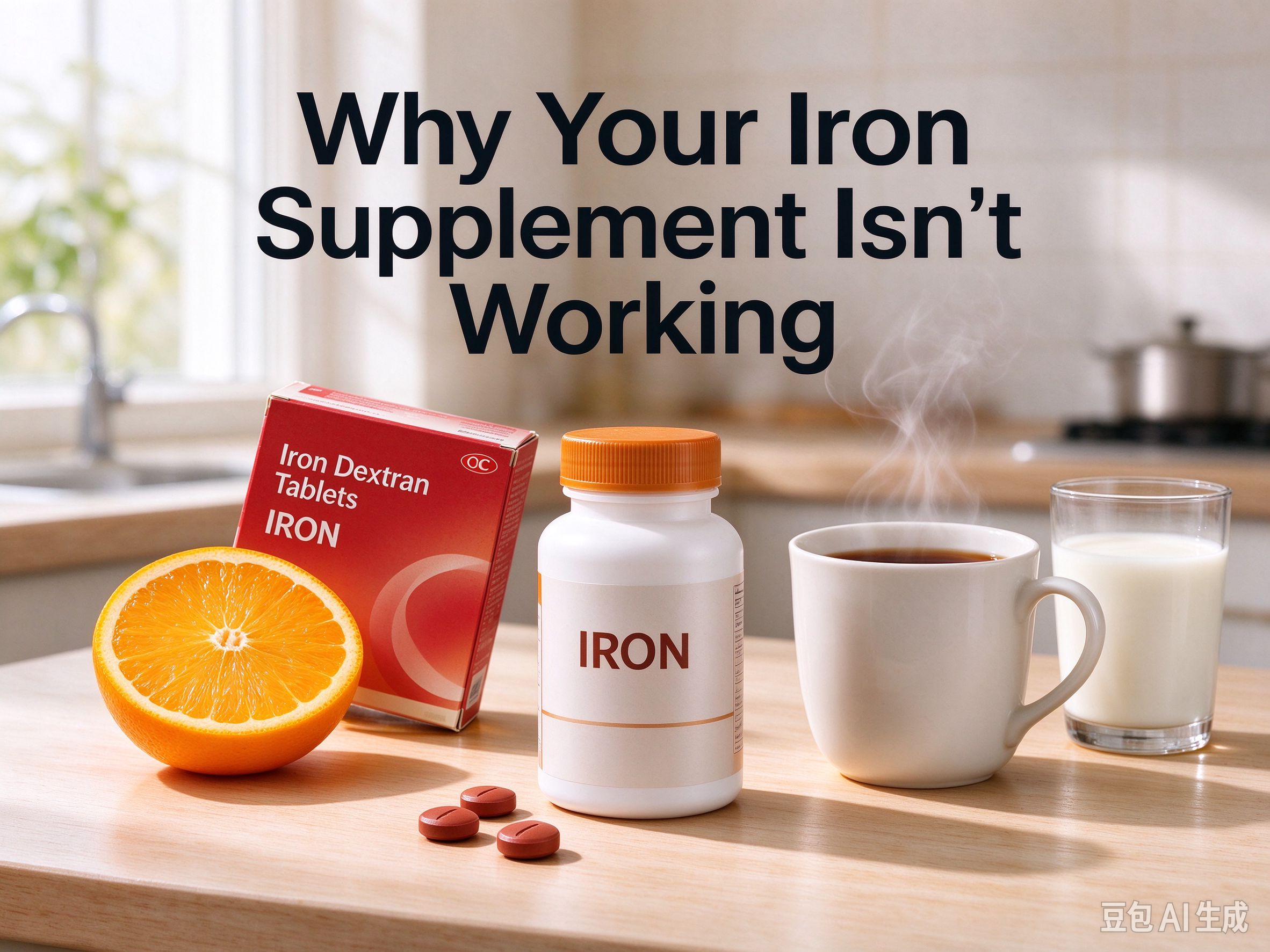
Most iron supplements that fail aren’t too weak. They’re taken at the wrong time, with something that blocks them, or for a reason nobody investigated. Check the timing, the pairing, and whether anyone has asked why your iron is low. The dose is almost never the problem.
First, what “not working” actually looks like
Iron deficiency creeps in slowly, and the symptoms are easy to blame on everything else. Tiredness that doesn’t lift after a good night’s sleep. Breathless on stairs you used to take easily. Hair shedding more than usual. Brittle nails. Feeling cold when nobody else does. Some people start chewing ice, which is a strange one until you know it’s a classic sign.
Here’s the part that makes people give up too early: hemoglobin usually starts to climb within a few weeks, and ferritin — the storage form — lags behind it, which is why treatment often continues for about three months after hemoglobin normalises. If you’ve been taking iron for three weeks and still feel flat, that’s not failure. That’s the middle of the timeline.
The other direction happens too. People take iron for months, feel slightly better, and never find out what was draining them. Both stories come from the same missing step, which I’ll get to.
The timing problem nobody explains
Iron absorbs best on an empty stomach. It also irritates an empty stomach, which is why so many people end up taking it with breakfast — and quietly cancelling most of the dose.
Three common pairings do real damage:
Tea and coffee. Tannins bind iron in the gut. A cup of tea with your tablet can cut absorption substantially. Wait at least an hour, ideally two.
Milk, cheese, yogurt, calcium supplements. Calcium competes with iron directly, in the same dose. This is why “take with a glass of milk” is exactly the wrong instruction.
Whole grains, beans, bran. Phytates hold on to iron. Not a reason to avoid those foods, just a reason not to put them in the same hour.
What helps: vitamin C. A small glass of orange juice with the tablet is a genuinely useful habit, and it’s the one food tip that reliably shows up in the data rather than in blog posts. Acid also helps you absorb the cheaper forms of iron, which most pharmacy shelves are full of. These inhibitor and enhancer lists come from the NIH Office of Dietary Supplements iron fact sheet, which is worth reading in full if you want the primary version.
If your stomach can’t handle it empty, take it with something small that isn’t dairy and isn’t tea — a plain cracker or a slice of toast, a banana. Half a dose absorbed is better than a full dose rejected.
If you are the person in your family who reads the labels, subscribe — one email when something new is published, nothing sold.
Why taking it every day may be the problem
This one surprises people who’ve done everything else right.
Iron isn’t absorbed continuously. One decent dose triggers a hormone called hepcidin, which blocks further iron uptake for roughly a day. So if you take a tablet every morning, a fair part of what you swallow on day two walks straight through. Taking it on alternate days often absorbs better than taking it daily, and it’s easier on the gut.
That doesn’t mean you should change a frequency your doctor set for diagnosed anemia. It does mean that if you’re self-treating a borderline low ferritin and getting nowhere, daily dosing may be working against you.
What makes iron harder to absorb
Some of this is about food, but a surprising amount is about other medicines.
Acid-suppressing drugs are the big ones — proton pump inhibitors and H2 blockers. Iron needs stomach acid to be released from the tablet and reduced into a form you can absorb. Take away the acid and you take away a chunk of the dose. If you’ve been on a PPI for reflux for years and your iron has been drifting down, those two facts are probably connected.
Antibiotics in the tetracycline and quinolone families bind iron directly. So do thyroid tablets — levothyroxine and iron should be at least four hours apart, in both directions.
None of these are reasons to stop your other medicines. They’re reasons to space things out, which is exactly the sort of thing worth asking a pharmacist about rather than guessing.
Black stools, constipation, and what to do about it
Iron turns stool black or dark green. That’s unabsorbed iron, not blood. It looks alarming and is almost always harmless.
The exception: black, tarry, sticky stool with dizziness, a racing heart, or vomiting blood is a different situation — that’s bleeding, and it needs a doctor, not a supplement adjustment.
Constipation is the most common reason people quit. Water, fibre and movement help. Some people do better on a different form: ferrous bisglycinate is usually gentler than ferrous sulfate, though it carries less elemental iron per tablet, so read the number rather than the marketing — the same label problem that runs through magnesium supplements. If you are not sure which number on the panel is the iron itself, the Supplement Facts panel has a fixed grammar, and it takes about five minutes to learn.
The question that matters most: why is your iron low?
This is where most self-treatment falls apart.
Iron doesn’t disappear on its own. It goes somewhere, or it never arrives.
In women before menopause, heavy periods are the usual answer, and they’re often normalised for years. In men and in women after menopause, unexplained iron deficiency needs the gut looked at, because the most common cause is slow blood loss from the digestive tract.
Then there’s absorption. Celiac disease, untreated H. pylori infection, inflammatory bowel disease, previous stomach surgery — all of these can leave you taking a perfectly good supplement that never gets into you. Vegetarian and vegan diets raise the risk too, not because plants are bad, but because plant iron is absorbed less efficiently and needs more help.
If nobody has asked why, the supplement is just topping up a leak.
When tablets aren’t enough
Some situations need intravenous iron: severe anemia, intolerance to oral iron, ongoing blood loss, absorption problems, or a timeline that doesn’t allow for months of tablets. That’s a hospital decision, not a self-treatment one.
What doesn’t work is doubling or tripling the dose at home. More tablets mostly means more constipation, more nausea, and a blacker stool — not proportionally more iron in your blood. One footnote on numbers, because it trips people up: the 45 mg upper limit for adults applies to total daily intake from food plus supplements, not to a treatment course your doctor has set — a therapeutic dose can legitimately sit above it. What it does mean is that stacking iron on top of a multivitamin that already contains it is usually pointless, and doses above 25 mg also pull down zinc absorption.
Before you buy another bottle
Read the elemental iron, not the compound weight. A tablet labelled “ferrous sulfate 325 mg” contains about 65 mg of elemental iron. “Ferrous gluconate 300 mg” is around 35 mg. The big number on the front is usually the salt, and the number that matters is the smaller one in the Supplement Facts panel.
If you’ve been on iron for four to six weeks with no change in how you feel, get tested rather than upgrading: hemoglobin, ferritin, and mean cell volume. Ferritin tells you what’s in storage; hemoglobin tells you what’s already circulating. The usual cut-off is ferritin below 30 mcg/L for iron deficiency and below 10 for iron deficiency anemia — the NIH fact sheet lists both. They move on different schedules, and a normal hemoglobin with a low ferritin still needs attention.
And keep the bottle away from children. In the FDA’s own wording, accidental overdose of iron-containing products is “a leading cause of fatal poisoning in children under 6” — and the tablets look like sweets.
One more group to name: if you’ve been told you have haemochromatosis or iron overload, don’t take iron unless your own doctor says so. More iron is the last thing your body needs.
And if you want a sense of how often the bottle is not what the label says, tejocote root is the current example — a supplement sold for one thing, containing something else.
The short version
Take it away from tea, coffee, dairy and calcium. Consider alternate days. Ask what’s blocking absorption — including your prescriptions. And find out why your iron is low, because that’s the only answer that stops you from buying the same bottle again next year.
One more thing worth doing before the next bottle: the advertising red flags are usually visible before you pay, not after.
If you want the plain-language version of this whenever a new bottle appears in your house, subscribe — one email when something is published, nothing sold.
If someone in your family has been on iron for a year and is still tired, send them this. It’s more use in their phone than in yours.
Medical note: This is general information about how iron supplements behave, not a treatment plan. Diagnosed anemia, suspected bleeding, pregnancy, or iron therapy in children should be managed by your own doctor or pharmacist, who can see your blood results.


Leave a Reply