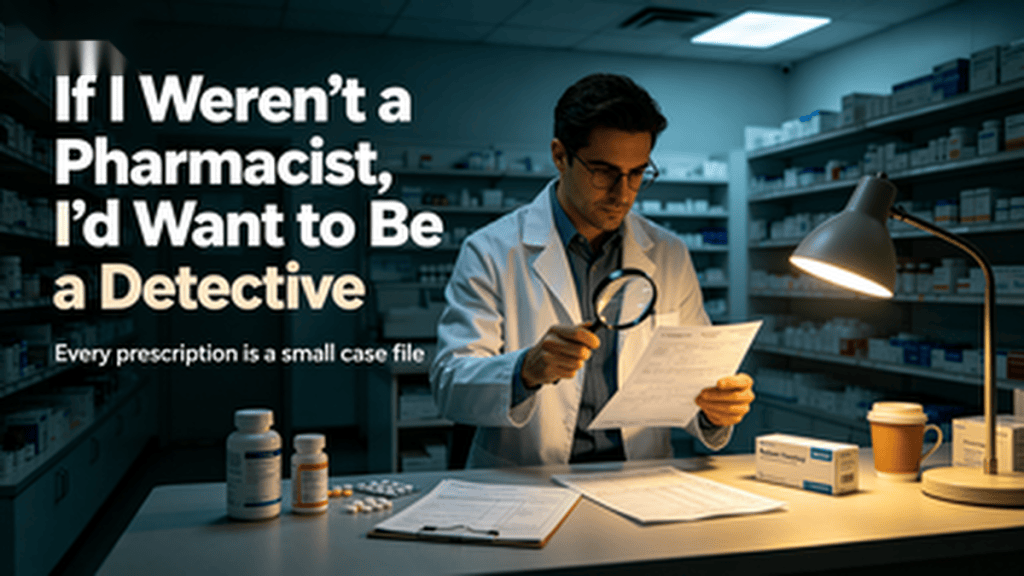


If I Weren’t a Pharmacist, I’d Want to Be a Detective
Answering the WordPress daily writing prompt: “If the pay were the same, what would you do instead?”
If the salary were identical, I’d want to be a detective. A homicide detective, specifically. The kind with a cool nickname and a desk lamp that casts dramatic shadows.
I have a name badge and a stool that wobbles. But hear me out.
I’ve been a hospital pharmacist for seventeen years — and I’ve been doing detective work the whole time. I just never got the badge, the trench coat, or the dramatic parking spot.
Every prescription is a small case file.
I’ve flagged interactions that doctors waved off with an “it’s been fine.” More than once, the labs later proved the concern wasn’t theoretical. I’ve caught duplicate therapies hiding behind brand names. I’ve asked “are you taking anything else?” and watched patients develop a sudden, very convenient amnesia.
The crime scene is usually a shoebox of supplements. The suspect is always “a friend’s recommendation.”
What you need for this work is not a magnifying glass. What you need is a medication list, plus the courage to ask that follow-up question. Mine usually has a coffee stain on it.
Pharmacists are trained to think like detectives. Nobody tells us that.
We’re trained in chemistry, pharmacology, and the quiet art of distrusting a tidy story. A patient says “I just take these vitamins.” Translation: I have a shoebox of unlabeled bottles at home, and “just” is doing a lot of heavy lifting in that sentence. A caregiver says “he only takes his morning pill.” Translation: the blister pack tells a different story, and nobody has been counting.
We don’t interrogate suspects. We ask the third question, the one nobody else thinks to ask: “What did you take this morning — and did it come from a bottle you recognize?”
The history of medicine is full of our best detective stories.
Goldberger ate a dead man’s rash to prove pellagra wasn’t contagious. Kelsey refused to approve thalidomide for nineteen months while the whole world called her difficult — and an entire generation of American babies never needed that lesson. Neither of them wore a trench coat either. They wore what we wear: evidence, patience, and a refusal to let momentum win.
I’ve spent the past few weeks writing about those two cases for this blog. And the whole time I kept thinking: that’s me. That’s every pharmacist I know. We don’t close cases with a click of handcuffs. We close them with a phone call to the prescriber, a corrected label, a patient who walks out safer than they walked in.
So, would I change jobs if the pay were the same?
I thought about it honestly. A real detective gets closure. We rarely do — the patient gets better and leaves, and we never learn how the story ended. There’s a version of me that would love that closure. And a version that would miss this:
The mother asking about her son’s cough syrup. The old man who wants to know why his new pill looks different from last month’s. The teenager too embarrassed to ask about the rash, who finally whispered it at the counter. Detectives meet people on their worst day. I meet them on their ordinary ones — and ordinary, it turns out, is where most of the safety happens.
So if the salary were identical — I’d stay.
The badge was never the point. The case file was never the paperwork. It was always the same quiet work: look closer, ask the question, catch it early.
Pharmacist is just the title. Detective is the job description.
My desk lamp just doesn’t cast dramatic shadows. Yet.
Want more pharmacist detective deep dives? Subscribe to get updates straight to your inbox.
No spam. Unsubscribe anytime.


Leave a comment