If you’ve seen Kung Fu Panda 3, you remember General Kai. No sword. No fire. He just presses his palm down — and drains the qi his opponent spent a lifetime building, leaving behind a hollow shell that does his bidding.
The movie exaggerates, of course. But it gets one thing right: when your qi goes wrong, you can look perfectly fine and still feel off everywhere.
Let me be clear before we go further. The qi in that film is special effects — something you can absorb, release, and use as a weapon. Real qi is not a superpower. As I explained in [the previous post], it’s simply the invisible work that keeps your body running. Nobody can steal it from you. But it can quietly go wrong in six ways — and every one of them happens inside you.
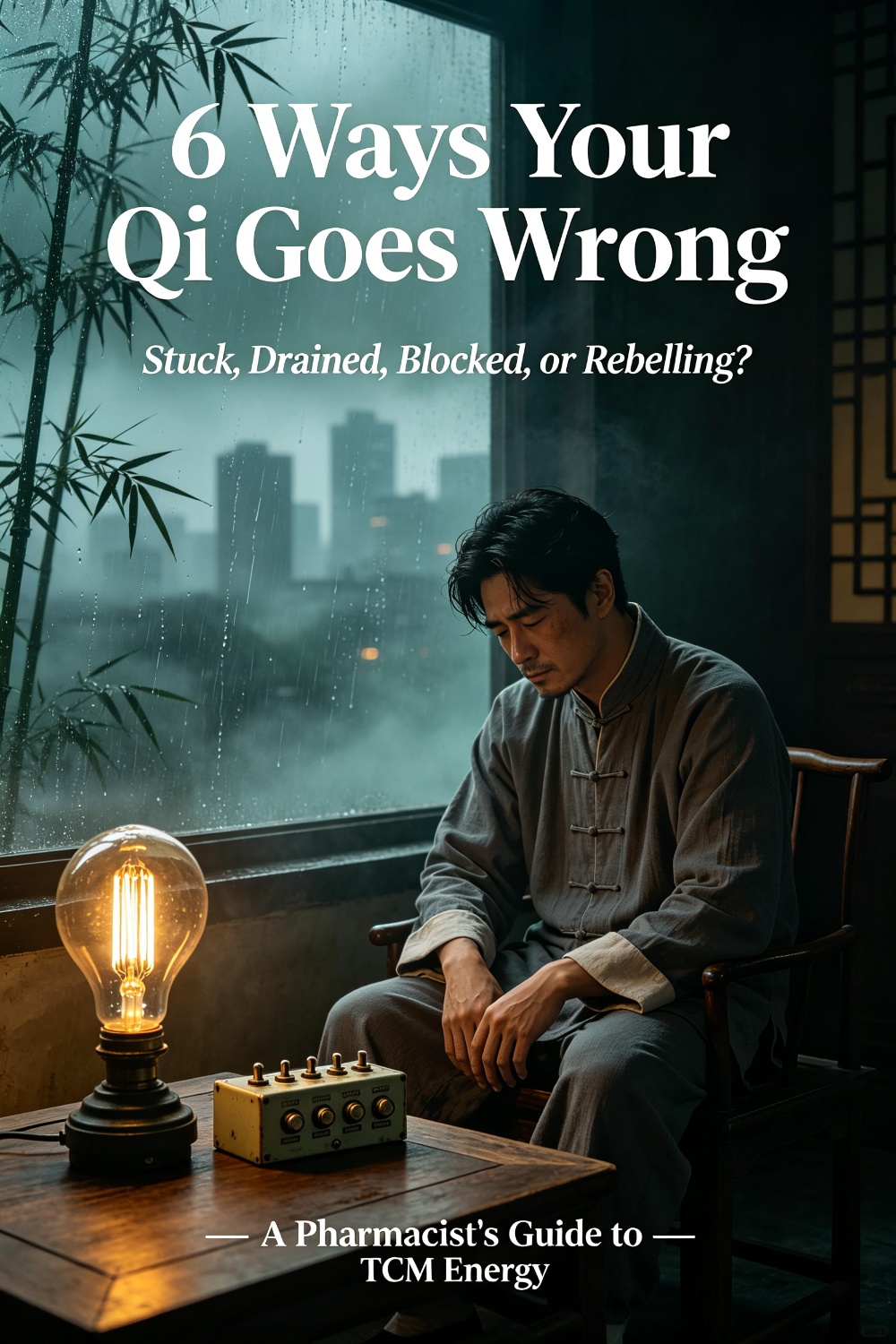
Remember the analogy from the last post? Picture your body as a house full of appliances. Qi is the electric current moving through the wires. The lights need it. The water pump needs it. The refrigerator needs it to stay cold.
Today we’re looking at six faults that can happen in that wiring. Chinese medicine sorts qi problems into six categories. Learn these six, and most of what your elders mean by “qi not running smoothly” will start to make sense. More importantly, you’ll understand one thing: two people can both say “I have no energy” — and one needs tonifying while the other needs unblocking. Get it backwards, and you make things worse.
1. Qi Deficiency: Not Enough Power, Dim Lights
The power isn’t out. The voltage is just low — the lights burn dim, the fridge hums weakly, and nothing feels quite right.
People are the same. You haven’t done heavy work, but you’re tired. Your voice is soft. Two flights of stairs leave you breathless. You sweat at the slightest effort, and your face looks pale.
This is the most common pattern, and it splits in two directions. When it leans toward the lungs, you catch colds easily, get short of breath, and run out of voice. When it leans toward the spleen, you bloat after a small meal, feel sleepy after eating, and your stools never quite firm up.
I saw this clearly years ago, when I rented a sixth-floor apartment and climbed those stairs every day. A neighbor, Mr. Li, climbed them too — but I slowly noticed something off. Every time he reached the top, he was gasping in a way that was rare for his age. I asked a few more questions. He told me he felt sleepy after every meal, and his stool was always loose. Put those together, and I had my answer: this wasn’t ordinary tiredness. It was qi deficiency — showing up in both his lungs and his spleen.
2. Qi Sinking: Nothing Holds Things Up
When qi deficiency drags on, it’s not just weakness anymore. It’s loss of support. The wire droops, and nothing stays hung.
You feel it as heaviness: a sinking, dragging sensation in the lower belly, worse after standing or when you’re worn out. Women may notice heavier periods. You may find yourself running to the bathroom often, or dealing with hemorrhoids. In Chinese medicine this is called “sinking of middle qi” — the spleen and stomach no longer have the strength to lift. There’s a classic formula, Buzhong Yiqi Tang, and the name alone tells you what it’s for. (Mentioned here only to illustrate TCM theory — not a prescription.)
3. Qi Stagnation (Stuck Qi): Traffic Jam, Power That Can’t Get Through
Qi stagnation — what many people simply call “stuck qi” — is the pattern most often mistaken for deficiency. You’re not short of power. The current is stuck somewhere and can’t pass.
It feels like bloating, tightness, and wandering discomfort — a pinch here, a twinge there, moving around with no fixed spot. Stress and anger make it worse. You sigh a lot, and a long sigh actually makes you feel better. Burping or passing gas brings relief too. In TCM, the liver keeps qi moving smoothly; when liver qi gets blocked, the whole body follows. The classic formula Xiaoyao San is designed to reopen that road. (Again, theory only — not a prescription.)
I remember a woman who came to the counter for a consultation. She told me she was deficient in both qi and blood, and planned to buy ginseng and astragalus to tonify. I didn’t jump to fill the order. I asked her one question first: “How did you conclude you’re deficient?” She listed her symptoms, and two of them made me pause — her periods often contained clots, and she had a stabbing pain in her lower belly. There’s an old saying in Chinese medicine: “where there is blockage, there is pain.” This wasn’t deficiency. This was blockage — qi stagnation, with blood stasis following behind it. Adding tonics on top of that would likely make things worse. I didn’t hand her the supplements. I encouraged her to see a doctor in person first.
A lot of people assume fatigue means deficiency. They tonify and tonify — and end up more bloated and more congested in the chest. They’re not deficient. They’re stuck. When you pour tonics into a blocked pipe, you’re just adding pressure to a jam.
4. Qi Rebellion: Flowing the Wrong Way
What should go down instead rushes up.
Coughing, wheezing, hiccuping, nausea, vomiting, acid reflux — all of these are “what should descend, rising instead.” Stomach qi is meant to move downward; when it goes wrong, you vomit and reflux. Lung qi is meant to move downward too; when it rebels, you cough and wheeze. The corresponding formulas: Suzi Jiangqi Tang for the lungs, Xuanfu Daizhe Tang for the stomach. (Theoretical references only — not prescriptions.)
5. Qi Collapse: The Power Suddenly Goes Out
The electricity doesn’t leak slowly. It drains all at once.
After heavy sweating, major bleeding, or severe diarrhea, a person suddenly turns deathly pale, breaks out in cold sweat, can’t catch their breath, goes cold in the hands and feet, and the pulse becomes thin and weak — barely there. This is qi escaping along with fluids and blood.
This is an emergency. Don’t ride it out at home — call emergency services immediately. The classical formulas like Dushen Tang and Shenfu Tang are resuscitation measures meant for trained professionals, not something you brew yourself at home.
6. Qi Blockage: The Main Breaker Is Seized
Qi blockage is the mirror image of qi collapse. Collapse is energy leaking out. Blockage is energy sealed in. A burst pipe and a welded-shut valve are two different problems.
The signs: sudden fainting, clenched jaw, fists tightly shut, no response when you call — often triggered by a burst of rage. Again: call an ambulance, right away. TCM emergency formulas like Suhe Xiang Wan and Angong Niuhuang Wan are professional-grade medicines. They are not for self-administration.
Pharmacist’s Summary
Strip it down, and the six patterns fall into two camps. Qi deficiency and qi sinking: too little qi. Qi stagnation and qi rebellion: qi in the wrong place. Qi collapse and qi blockage: life-threatening emergencies. The treatments run in opposite directions — the first camp needs tonifying, the middle needs unblocking. One line is worth remembering: don’t unblock what needs tonifying, and don’t tonify what needs unblocking. Many people get worse not because their medicine is bad, but because the direction was wrong.
There’s something I see at the counter almost every week: someone feels “weak,” buys ginseng, astragalus, or deer antler, and loads up on tonics. But before you tonify, you have to know whether you’re genuinely deficient — or blocked. That’s a call I won’t make from across the counter. It needs a qualified TCM practitioner to see you in person. Herbs are never one-size-fits-all.
Back to General Kai. The qi he drained was movie magic — gone with one press of the hand. In real life, there’s no villain like that. What drains your qi is usually you: the late nights, the anger, the day spent sitting, the meal you overate. Most qi problems are habit problems — and that half of the equation, you can start fixing today.
Next time ([Part 3]), we’ll talk about qi and blood — how the two work together, and how when one goes wrong, it drags the other down with it.
This article is for educational purposes only and does not constitute medical advice. The formulas mentioned are used solely to illustrate TCM theory and should not be taken on your own. If you feel unwell or symptoms persist, please see a qualified healthcare professional in person.
Title: What Happens When Your Qi Goes Wrong? 6 Qi Disorders Explained by a Pharmacist (Part 2)
Excerpt: Qi can go wrong in six ways. Using a house-wiring analogy and two real counter stories, a pharmacist explains qi deficiency, stagnation and more — in plain English.
Category: TCM Guides
Tags: qi deficiency, qi stagnation, TCM, traditional Chinese medicine, qi: “the previous post” -> https://kailinpharmacist.com/2026/08/18/whatisqitcmbeginnersguide/ ; “Part 3” -> https://kailinpharmacist.com/2026/08/25/qi-and-blood-tcm-part-3/

Leave a comment