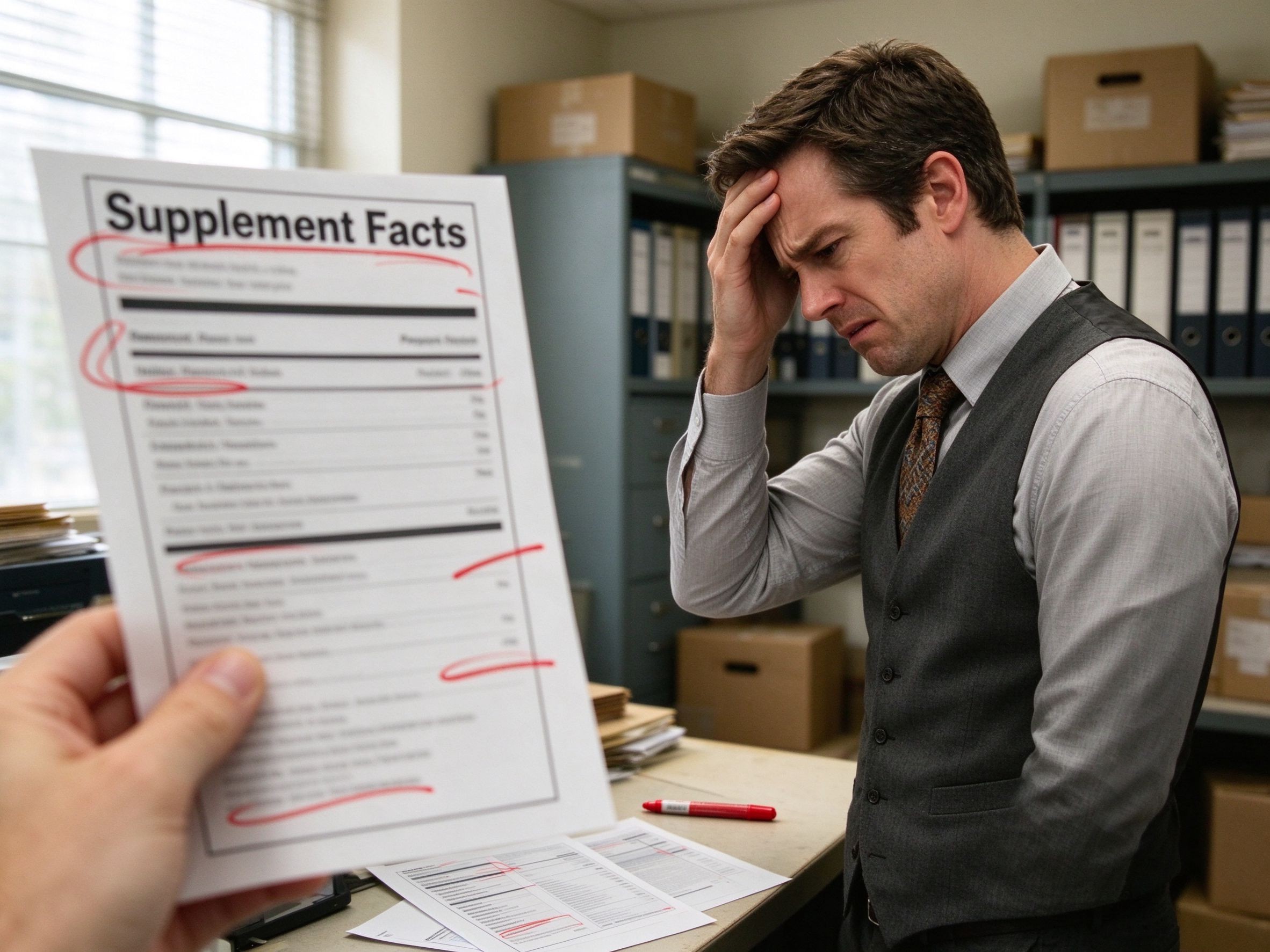
A warning letter dated September 13, 2024, names three Chinese classic formulas in its labeling section and cites four labeling violations. None of the four says the formulas are unsafe. Each one says the label did not follow the format. All four sit in the same small block on the bottle: the Supplement Facts panel.
That pattern repeats. In the letters I have read, herbal products are cited for formatting far more often than for ingredients, and the same four points come up again and again.
All three products in that letter were made by the company itself, under its own brand, in its own facility in Oregon. That detail matters more than it looks. When one company owns the formula, the specification file, the artwork and the finished bottle, nothing is lost in a handoff, and the panel still comes out wrong. The specification file lists the ingredients. The design file builds the panel. In my experience, nobody maps one onto the other, because the specification file answers “what is in it” and the regulation asks “what does the bottle say.”
1. The title has to read Supplement Facts
The letter states the labels failed “to present nutrition information on the nutrition label using the title, ‘Supplement Facts’” (21 CFR 101.36).
Brand owners usually get this wrong in one of three ways. They print Nutrition Facts, which belongs to conventional food. They invent a title — Supplement Information, Herbal Facts, Ingredient Profile. Or they skip the panel and print the ingredients on the back of the bottle. From a reviewer’s side, all three read the same: no panel. None of them is a drafting subtlety, either. Each is a choice someone made in the design file, and each is visible on the bottle before it ever ships.
2. Every dietary ingredient needs an amount per serving
Same letter: the labels failed to include “the quantitative amount by weight per serving of each dietary ingredient,” under sections 403(s)(2)(A)(ii) and 403(q)(5)(F) of the Act and 21 CFR 101.36.
Two failures account for most of it. The label gives 500 mg of a named herb and never states how many capsules make a serving — without that denominator, the number means nothing. Or a multi-herb formula is grouped under one blend name with a single total weight. As 101.36(c)(3) is written, grouping is allowed, but the total weight has to sit on the same line as the blend name, to the right of it. Move it down one line, or fold a single herb into the blend row, and the panel stops reading as a blend.
3. Botanicals need a plant part
This one was cited on its own, under section 403(s)(2)(C) and 21 CFR 101.4(h)(1): the label failed to identify “the part of the plant (e.g., root, leaves) from which each botanical dietary ingredient in the product is derived.”
FDA’s phrasing is worth keeping. “Herb” does not identify the plant part. Neither does Botanical Extract, nor Chinese Herbs. Those words look professional and tell a reviewer nothing about what is inside the capsule. If the whole plant is used, that has to be stated too.
4. Names must be common or usual names
Two examples, from the same letter.
The label listed “Citrus,” which FDA says is not the common or usual name of an ingredient. Citrus is a genus, not an ingredient. Green tangerine peel, bitter orange and aged tangerine peel all sit under it, and nothing on the label lets a reviewer tell which one is in the bottle.
The label also failed to declare the solvent used in the extract. Water, ethanol, or a water-ethanol mix — whichever it is, it belongs in the ingredient list.
Both fall under 21 CFR 101.4 and 101.36.
If you work on labels, this set walks through the panel one citation at a time. Leave an email and the next one arrives when it goes up.
Two more items outside the panel
One product was also cited under 403(r)(6): the structure/function statements on its label were not linked to the required FDA disclaimer (21 CFR 101.93(b)-(e)). One of the three was an unapproved new drug in addition to being a misbranded supplement, because wording on the company’s website and product catalog established an intended drug use.
Worth stating plainly: labeling is not what that letter is mostly about. It also lists more than a dozen products as unapproved new drugs and sets out a separate section of CGMP violations under 21 CFR Part 111. This piece covers only the four labeling citations, so “none of the four says the formulas are unsafe” does not mean “the products are fine.” It means the four things easiest to fix were also the four things still wrong.
The part that takes longer than four points
Four items is a short list. Each one splits into two or three real-world failure modes. Take the blend rule: the total weight goes one line below the blend name instead of the same line, or a single herb gets folded into the blend row, and the panel still passes a quick read. The order you check things in decides whether you catch that in ten minutes or lose an afternoon. Words first, then numbers. A panel that looks fine usually means the numbers were checked and the wording was skipped — and the wording is where three of these four citations land.
Risk is not spread evenly. A brand owner who imports under their own label generally carries the panel. A distributor reselling a finished, already-labeled product usually does not. The letters I read land on brand owners almost every time — a company that owns the formula and the artwork, with nobody on staff whose job is the label. Size is not the variable. Whether anyone actually owns the label is.
The warning letter, dated September 13, 2024, is public. Worth reading in full. The citations are quoted directly, and the products are ordinary formulas that any importer of Chinese herbals could already be shipping.
If you would rather start from the requirements than from a warning letter, the overview covers every piece of a compliant label, from the statement of identity to the adverse event address.
Every post in this set is filed under label compliance, in the order a label gets built. The rest of the set sits under the same tag.
I read these letters and write up what FDA actually cites, one at a time. If that is useful, subscribe and the next one lands in your inbox.
This is a reading of public FDA letters, not legal advice.